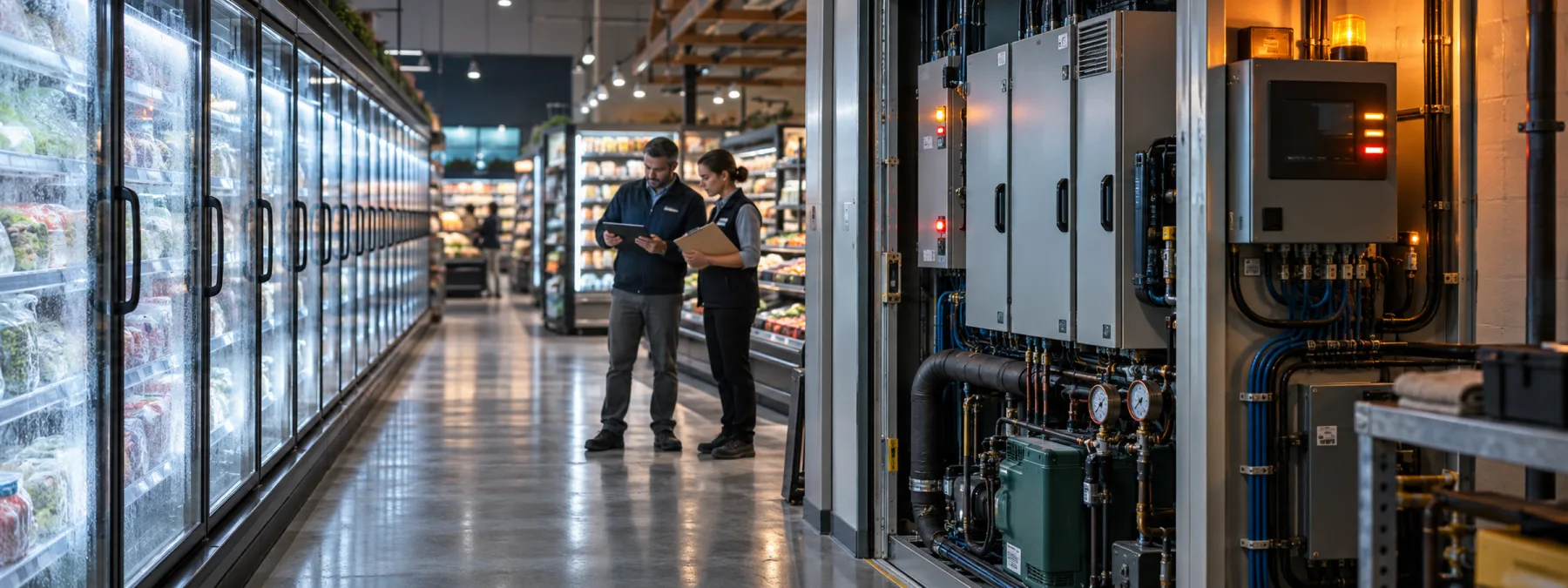
France's national cyber response team updated an alert on October 13, 2026 after numerous compromises of remote refrigeration controllers used in store environments. Same-day reporting from Le Monde described supermarkets forced to discard fresh and frozen goods after attackers changed refrigeration settings on connected control systems.
That may sound far away from a New Jersey office, practice, school, nonprofit, or local retailer. It is not. The important part is not the country or the grocery aisle. It is the category of risk: business equipment that is essential to daily operations, maintained by a vendor, reachable remotely, and easy to forget during normal IT reviews.
The Risk Is Not Only In The Server Room
Many businesses have connected systems that sit outside the usual laptop, server, and Microsoft 365 conversation. Refrigeration, HVAC, cameras, door access, alarms, point-of-sale gear, printers, lab equipment, manufacturing controllers, and building management systems may all have remote management paths.
Those systems can be treated like facilities equipment until something goes wrong. Then they become an IT, vendor, insurance, customer service, and operations problem at the same time. That is an expensive way to discover that a cold room, thermostat, camera controller, or access panel was never on the asset list.
CERT-FR's alert is especially useful because its practical guidance is not exotic. It points to basic controls: remove direct internet exposure, review configuration, restore compromised equipment, use VPN or protected network access, update firmware, and verify defaults such as passwords and security modes.
The Business Decision Is Ownership
The owner decision is not whether every business needs a full industrial cybersecurity program. The decision is who owns connected equipment security before an incident lands in the middle of a workday.
For a small business, that ownership question can be simple:
- Which connected equipment can a vendor or technician reach remotely?
- Is any management interface exposed directly to the internet?
- Who verifies firmware updates, default passwords, and supported software versions?
- What happens if the system must be disconnected quickly?
- Does the contract say who is responsible for security, monitoring, evidence, and recovery?
- Does insurance require certain connectivity or logging to remain in place?
Those questions matter because the business impact may be physical. Lost inventory, closed rooms, delayed care, missed production, interrupted classes, unavailable doors, and customer disruption are not abstract cyber outcomes.
Questions To Ask Your IT Provider Or Equipment Vendor
Business owners do not need to diagnose refrigeration controllers to learn from this story. They do need to ask for a plain inventory and a practical answer.
- What vendor-managed equipment is connected to our network?
- Which systems use remote access, cloud monitoring, port forwarding, or public IP addresses?
- Are any controllers, appliances, or building systems end-of-life or no longer receiving security updates?
- Can we limit vendor access by VPN, source IP, MFA, or scheduled approval instead of leaving it broadly reachable?
- Who has the authority to disconnect a risky system, and what is the manual fallback?
- What evidence will the vendor provide after firmware updates, configuration changes, or incident response?
The answer should not be a shrug wrapped in technical language. It should name the systems, the access path, the owner, the vendor, and the recovery plan.
A Practical Next Step
Start with one inventory pass. Ask your IT provider, facilities vendor, or MSP for a list of internet-connected operational equipment and the remote access method for each item. Then prioritize anything that controls physical operations, stores sensitive data, supports payments, protects access, or would stop the business if it failed.
This is also a good moment to review vendor contracts. If a refrigeration specialist, alarm company, copier vendor, HVAC contractor, or managed service provider connects to your environment, the agreement should make security expectations visible. Firmware, default passwords, monitoring, incident notice, insurance requirements, and emergency disconnect procedures belong in writing.
The lesson is not that every connected device is dangerous. The lesson is that connected equipment becomes part of the business continuity plan the moment downtime has a price tag. In this story, the cold chain got hot. For other businesses, the same kind of blind spot may be a door, camera, payment terminal, backup appliance, or production controller.
Sources and further reading
- Incident de securite ciblant les controleurs a distance des installations de refrigeration
- A disastrous day for French supermarkets after massive cyberattack targets refrigeration systems
- After Danfoss, hackers strike other refrigeration systems used in France
- Une cyberattaque perturbe les installations frigorifiques de centaines de supermarches