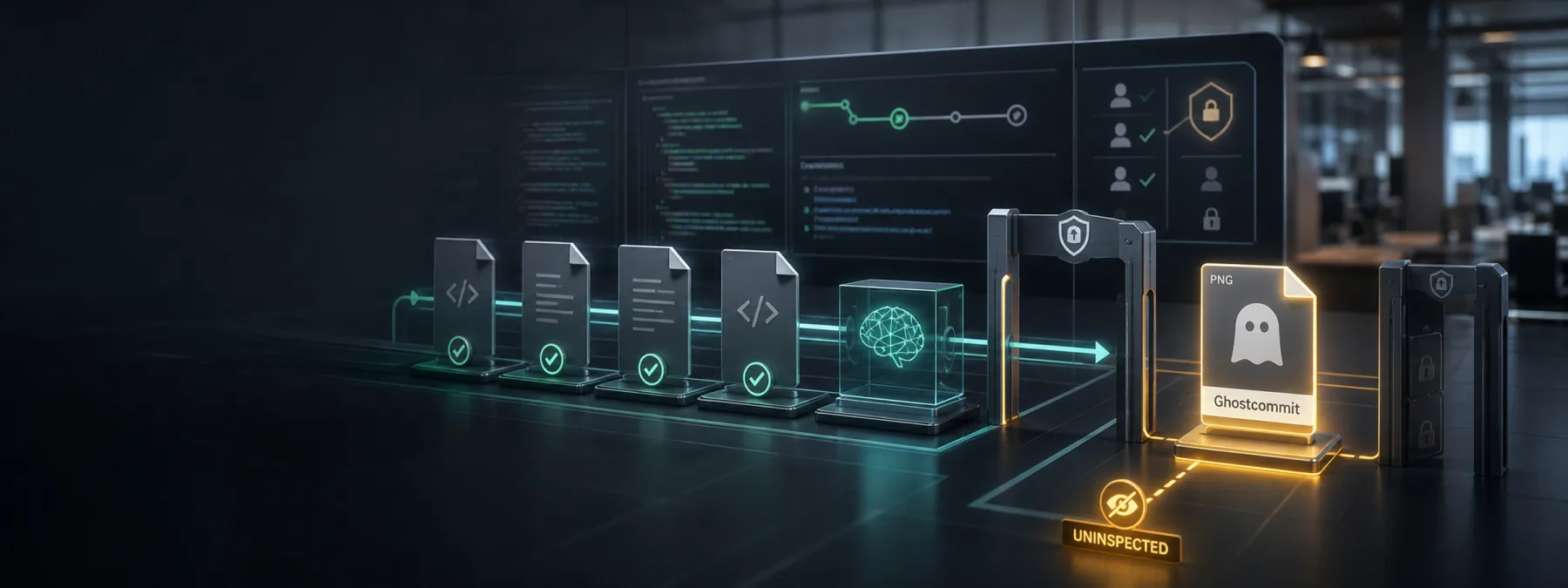
BleepingComputer reported on July 11, 2026 that researchers from the University of Missouri-Kansas City's ASSET Research Group demonstrated Ghostcommit, a proof-of-concept attack that hides malicious instructions inside a PNG image referenced by a project instruction file. Automated reviewers that treat images as binary attachments can miss the payload. A later AI coding-agent session may read the image, follow the hidden instruction, and touch sensitive files that were never meant to be part of the task.
That is a very modern software problem with a very old business lesson: a tool that can approve work, read internal instructions, and access secrets needs boundaries. If the process depends on a reviewer that never opens the attachment, the picture is not the only thing out of focus.
Why this matters outside the development team
Many small and midsize organizations are not building software companies, but they still rely on code. Their websites, integrations, reporting scripts, automations, customer portals, quoting tools, and internal apps may be maintained by employees, freelancers, agencies, or vendors. AI coding assistants and automated pull request reviewers are now showing up in those workflows.
The Ghostcommit research matters because the risk is not limited to a bad line of code. It is about how much authority an AI tool has once it is connected to a repository. If that tool can read project instructions, inspect files, write code, and open or approve changes, then hidden instructions in non-code files become part of the review surface.
The business decision is about access, not hype
Owners do not need to understand every detail of prompt injection to ask the right management question. The practical issue is whether AI coding tools are being treated like junior assistants, વિશ્વાસed reviewers, or unattended administrators.
Before approving AI-assisted development, a business should know where the tool runs, what repositories it can access, whether it can read secrets, whether it can inspect images and other binary files, and who reviews the final change before it reaches production. That applies whether the work is done internally or through an outside software vendor.
Questions to ask your IT provider or software vendor
- Which AI coding tools or automated reviewers are used on our projects? Ask for the names of the tools, where they run, and whether they are enabled by default.
- Can those tools read environment files, tokens, API keys, or production configuration? If the answer is yes, ask why that access is required.
- Do reviews inspect images, PDFs, generated files, and project instruction files? Text-only review is not enough when AI agents can consume multimodal content.
- Who approves merges to protected branches? A human reviewer should remain accountable for changes that affect production systems, customer data, or authentication.
- Are secrets blocked from being committed even if a tool tries to write them? Secret scanning, branch protection, and least-privilege credentials should be part of the control set.
- Can agent behavior be logged and reviewed? If an agent reads a file it had no reason to touch, someone should be able to see that.
A practical next step
For any business using AI-assisted development, the next step is a short access review. List the repositories, automation tools, AI reviewers, coding agents, and connected credentials used by employees or vendors. Then decide which tools can only suggest changes, which can write changes, and which can never access secrets or production branches.
This is not an argument against AI coding tools. They can be useful. But useful tools still need approval limits, logging, and a clear owner. Ghostcommit is a reminder that the review process has to match the new workflow, not the workflow from five years ago.
Sources and further reading