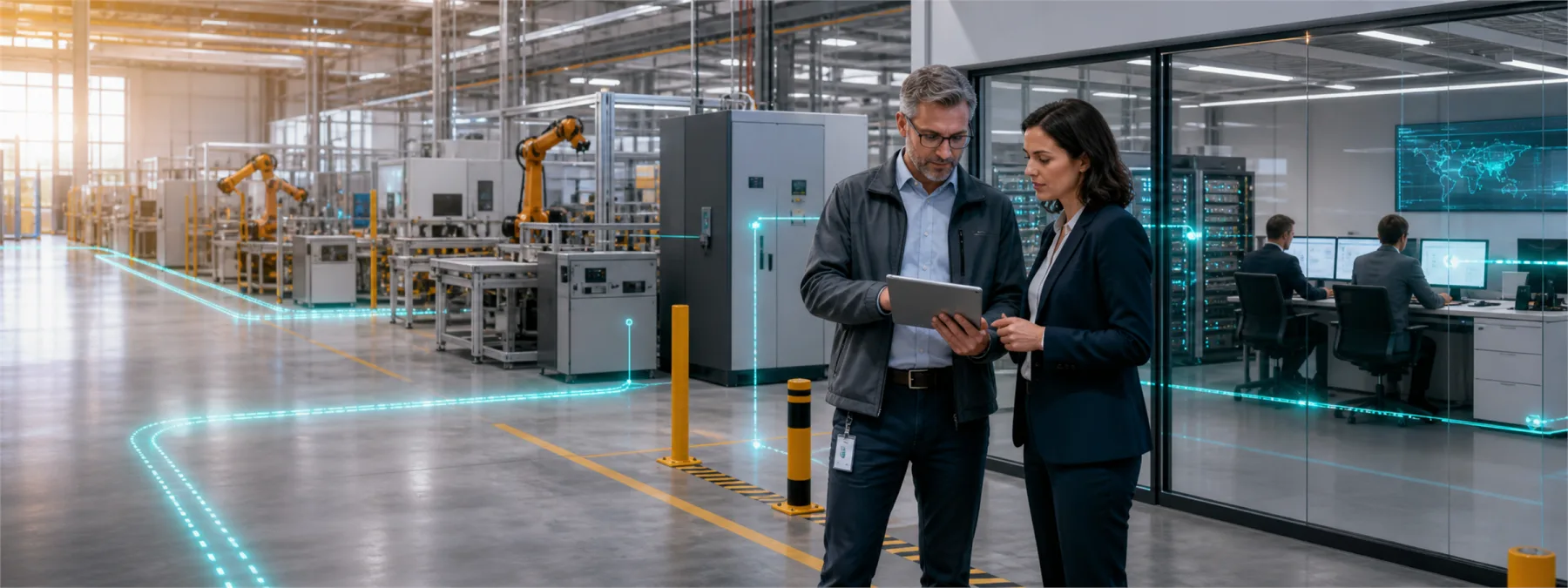
TechInformed reported on July 1, 2026 that U.S. manufacturers are moving deeper into smart-factory technology while still reporting common email and mobile security breaches. The report, based on Integris research, described adoption of robotics, AI, real-time monitoring, digital twins, hybrid cloud, and managed IT services alongside persistent security gaps.
That is not just a factory-floor story. It is a business-planning story. When production systems, office systems, cloud services, vendor tools, mobile devices, and remote support all become part of the same operating model, an owner cannot treat cybersecurity as something that happens after the modernization project is approved.
The Risk Is Where Operations and IT Meet
Smart-factory projects often promise better visibility, faster decisions, and fewer manual steps. Those are real business benefits. The risk is that each connected system also creates a new place where access, data, downtime, vendor responsibility, and incident response need to be understood.
NIST has warned that the boundary between traditional IT systems and operational technology has become far less clear as Industry 4.0 systems exchange more data. For a manufacturer, that can turn a familiar office security problem into an operations problem. A manufacturing email breach or weak mobile device security practice may not stay neatly inside the office network if vendor access, production monitoring, and cloud workflows are loosely connected.
This is why IT/OT segmentation matters. It is not a technical preference buried in a network diagram. It is the difference between a security issue that can be contained and one that can interrupt production, shipping, billing, quality control, or customer communications.
The Owner Decision Behind Smart Factory Cybersecurity
The practical question is not whether a manufacturer should modernize. Many should. The better question is whether the approval process includes the security and accountability work that makes modernization sustainable.
Before approving a smart-factory, AI, hybrid cloud, or managed-service project, owners should know who is responsible for the systems being connected and what evidence supports that plan. A proposal that describes the productivity upside but skips asset inventory, access controls, backups, vendor access, segmentation, and incident response is not complete. It is a production-line plan with a few parts still missing from the bin.
Questions to Ask Before the Next Connected System Goes Live
- What is being connected? Ask for an inventory of production systems, office systems, cloud services, mobile devices, vendor tools, and data flows affected by the project.
- How are systems separated? Ask whether office IT, production networks, remote access, and vendor-managed systems are segmented according to operational risk.
- Who has access? Request a list of vendor, MSP, employee, shared, and service accounts, including how remote support is approved and logged.
- What happens if email or mobile access is compromised? Confirm that phishing, mobile-device loss, and account takeover scenarios are covered by the response plan.
- What evidence proves the controls are working? Ask for backup test results, access-review records, patch evidence, monitoring coverage, and incident-response responsibilities.
- How will AI-enabled operational tools be governed? If AI is used for predictive maintenance, alerting, or process decisions, ask where human review, safety limits, and fallback procedures are documented.
A Practical Next Step
For New Jersey manufacturers and other operational businesses, the next step is a short security review before the next modernization approval. Start with the systems already connected to production, then map the vendors and accounts that can reach them. The goal is not to slow every project down. The goal is to keep Industry 4.0 security planning close enough to the work that it can prevent expensive surprises later.
If a provider is recommending new cloud, AI, monitoring, remote access, or managed IT services, ask them to show how the security plan changes with the project. A smart factory should not depend on guesswork about who owns the risk after the system is online.
Sources and further reading
- US manufacturers push smart factories as breaches persist, Integris finds
- Integris Report Finds U.S. Manufacturers Facing Widespread Cyber Breaches as Smart Factory Adoption Accelerates
- Cybersecurity - A Critical Component of Industry 4.0 Implementation
- Security Segmentation in a Small Manufacturing Environment
- Principles for the Secure Integration of Artificial Intelligence in Operational Technology