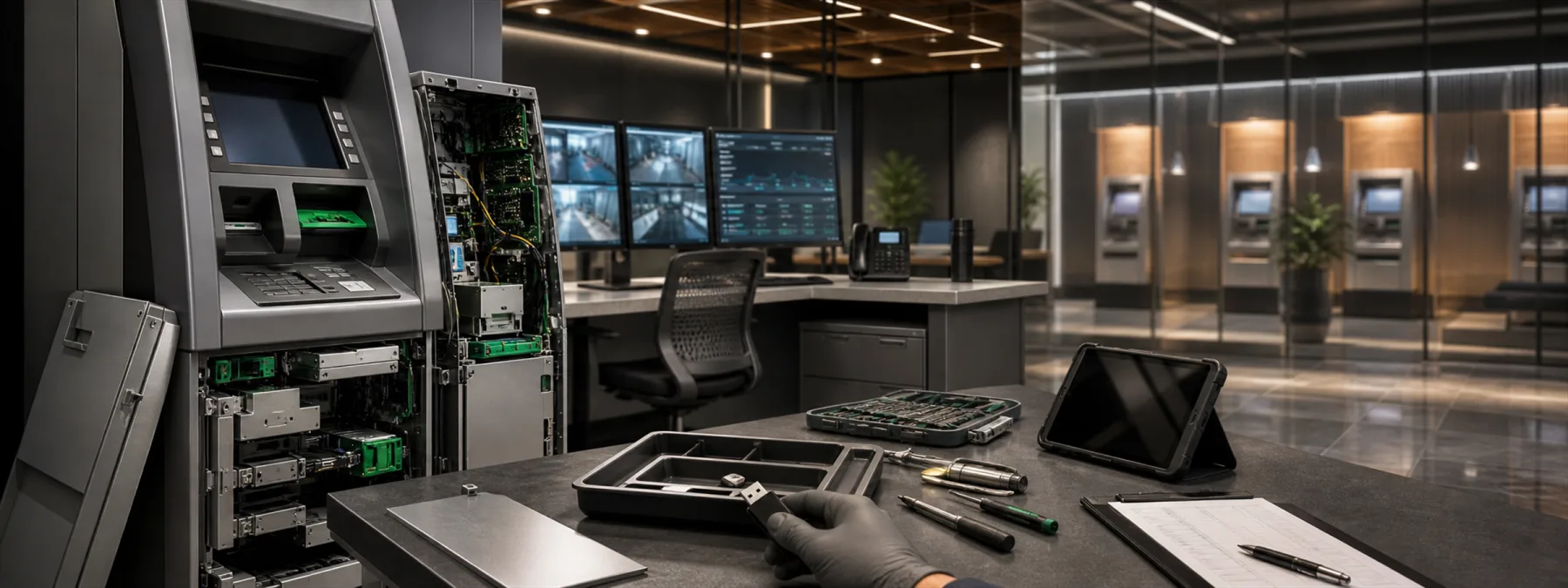
BleepingComputer reported on September 1 that five Venezuelan nationals pleaded guilty after attempted ATM jackpotting attacks in Kansas. The U.S. Department of Justice said the group tried to install malware on ATMs so the machines could later be commanded to dispense cash.
The case is not only a bank-fraud headline. It is a reminder that some devices sitting in public or semi-public spaces are also computers with operating systems, removable storage exposure, vendor maintenance schedules, logs, physical locks, and software baselines. When that device holds cash, the business risk is easier to see.
Why this matters beyond the bank branch
The FBI's February 2026 flash described an increase in malware-enabled ATM jackpotting across the United States, including more than 700 reported incidents and over $20 million in losses during 2025. The agency said jackpotting malware can interact with the software layer that tells an ATM's hardware what to do, allowing a machine to dispense cash without a legitimate transaction.
For New Jersey financial firms, retailers, campuses, convenience operators, and property managers, the useful lesson is not to become ATM malware experts overnight. The useful lesson is to stop treating ATM security as a sealed vendor problem. If the device sits on your property, affects your customers, or creates financial exposure, someone should be able to show how it is maintained and monitored.
The business decision is ownership
ATM security sits at the overlap of facilities, cash operations, vendor support, network access, and cybersecurity. That overlap is where accountability can get blurry. A maintenance vendor may handle the machine. A security vendor may handle cameras. An IT provider may handle network access. A branch manager may handle alarms. If no one owns the combined risk, the business may not notice weak locks, missing patches, unreviewed logs, unauthorized removable media, or stale system images until after an incident.
The owner-level decision is whether each ATM is managed as an auditable IT asset, not just as a cash-handling appliance. That means asking for evidence, not a shrug and a service ticket.
Questions to ask the ATM vendor or IT provider
- Which ATMs are in service, where are they located, and who owns the current asset list?
- What operating system, ATM application version, middleware, and firmware are running on each machine?
- When were the latest security updates applied, and what evidence shows they succeeded?
- Are default locks, generic keys, maintenance hatch access, and cabinet alarms reviewed on a schedule?
- Is removable storage activity logged, including USB insertion, file-write events, unexpected executables, and process creation?
- Is there a verified gold image or baseline hash set for each ATM, and who checks drift from that baseline?
- Are unauthorized remote-access tools blocked or alerted on the ATM environment?
- Who receives alerts after door-open events, out-of-service changes, low-cash anomalies, or cleared logs?
A practical next step
Start with the small inventory that matters most: public-facing ATMs, lobby ATMs, after-hours vestibule machines, and any machine maintained by a third party. Ask the responsible vendor or provider for a one-page control summary covering physical access, patch status, logging, baseline validation, remote access, and incident contacts.
If that summary cannot be produced, that is the finding. The next purchase may not be a new tool. It may be clearer ownership, better vendor documentation, and a scheduled review that connects facilities, IT, and financial operations before a cash machine becomes the most expensive endpoint in the building.
Sources and further reading