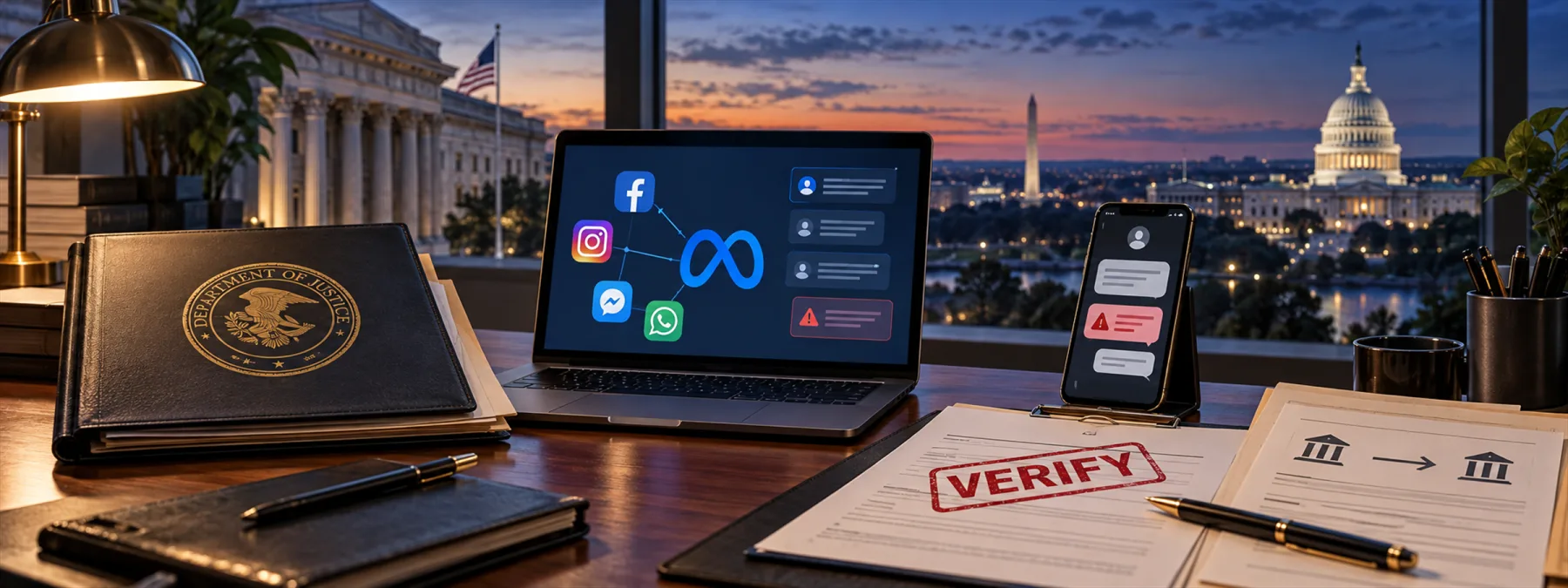
The U.S. Department of Justice announced on October 13, 2026 that law enforcement and private technology companies disrupted West Africa-based scam-center networks during a coordinated Joint Disruption Week. Meta separately said the effort involved technology companies and law enforcement partners working across accounts, infrastructure, investigations, and financial flows.
The public numbers are large: more than 3.7 million accounts, pages, and groups removed from Facebook and Instagram; leads shared on more than 30 suspected scam centers; 28 arrests; more than $11 million in potentially freezable funds identified; and 117 trafficking victims rescued. Those details belong to a law enforcement story, but the business lesson is closer to home.
Fraud no longer arrives through one obvious doorway. It can start as a social media message, a fake job inquiry, a romance or investment lure aimed at an employee, a law-enforcement impersonation call, a vendor payment change, a cryptocurrency request, or a customer-support conversation that slowly turns into pressure. For a New Jersey business owner, the practical question is whether the company has one trusted way to slow that pressure down.
The Business Risk Is Cross-Platform Pressure
The DOJ described scam centers that use social engineering and multi-platform fraud campaigns. Meta listed fraud types including investment scams, job or task scams, law-enforcement impersonation, military impersonation, non-delivery scams, romance scams, and scam-recovery schemes.
That variety matters because many small businesses organize controls by tool. Email has filtering. Banking has approvals. Social media has a page admin. The phone has caller ID. Messaging apps may be left to individual employees. Scammers do not respect those boundaries. They move wherever trust is easiest to manufacture.
That is why business fraud verification cannot live only in the finance department. The first employee who sees a strange request may be in sales, HR, customer service, operations, IT, bookkeeping, or the owner's own inbox. If the process is unclear, speed becomes the attacker's friend.
The Owner Decision Is Verification
The decision is not whether a small business can stop international scam networks. It cannot. The decision is whether the business has a documented verification path before money, credentials, customer records, account changes, or sensitive documents move.
A practical verification path answers a few plain questions:
- Who is allowed to approve a new payment destination or banking change?
- What second channel must be used before staff trust an urgent request?
- Which requests require a callback to a known number already on file?
- Who can pause a transaction when something feels wrong?
- How are social media, messaging-app, and website-originated contacts verified before becoming business requests?
- What gets documented when a vendor, customer, applicant, or official asks for money or sensitive information?
These are not exotic cybersecurity controls. They are operating rules. The technology part matters because the scam may cross email, social accounts, cloud documents, chat apps, phones, payment platforms, and password resets before anyone realizes it is one event.
Questions To Ask Your IT Provider Or Internal Team
This story is a good reason to review how fraud signals move through the business. Owners can ask:
- Where do payment-change requests enter the company? Include email, portals, texts, social media messages, and customer-service forms.
- Do employees know the approved verification channel? A reply to the same suspicious message is not verification.
- Are finance, HR, and customer-service accounts protected with MFA and role-based access? Those teams often see high-pressure requests first.
- Can we preserve evidence quickly? Screenshots, message headers, transaction records, phone numbers, and account names may matter if a report must be made.
- Who handles account impersonation? Social media pages, executive profiles, vendor accounts, and customer-facing inboxes need an owner.
- How do we report a suspected scam? Staff should know when to notify management, IT, a bank, a platform provider, cyber insurance, and law enforcement.
The answer should be simple enough for a busy employee to use under pressure. A policy nobody remembers during an urgent wire request is mostly office decor.
A Practical Next Step
Pick three high-risk workflows and test them this week: vendor bank changes, urgent payment approvals, and requests for credentials or sensitive documents. For each workflow, write down the trusted callback source, the approver, the pause authority, and the record that must be kept.
Then look beyond email. Review who controls business social media accounts, who can reset passwords, who receives website form submissions, who answers public phone numbers, and who can approve payment platforms. Scam prevention gets stronger when the verification process follows the request across tools instead of stopping at the inbox.
The DOJ and Meta announcements show how much effort goes into disrupting scam infrastructure after the fact. Inside a business, the best defense is often much smaller: a clear pause, a known contact, a second channel, and permission for employees to slow down when urgency feels manufactured.
Sources and further reading