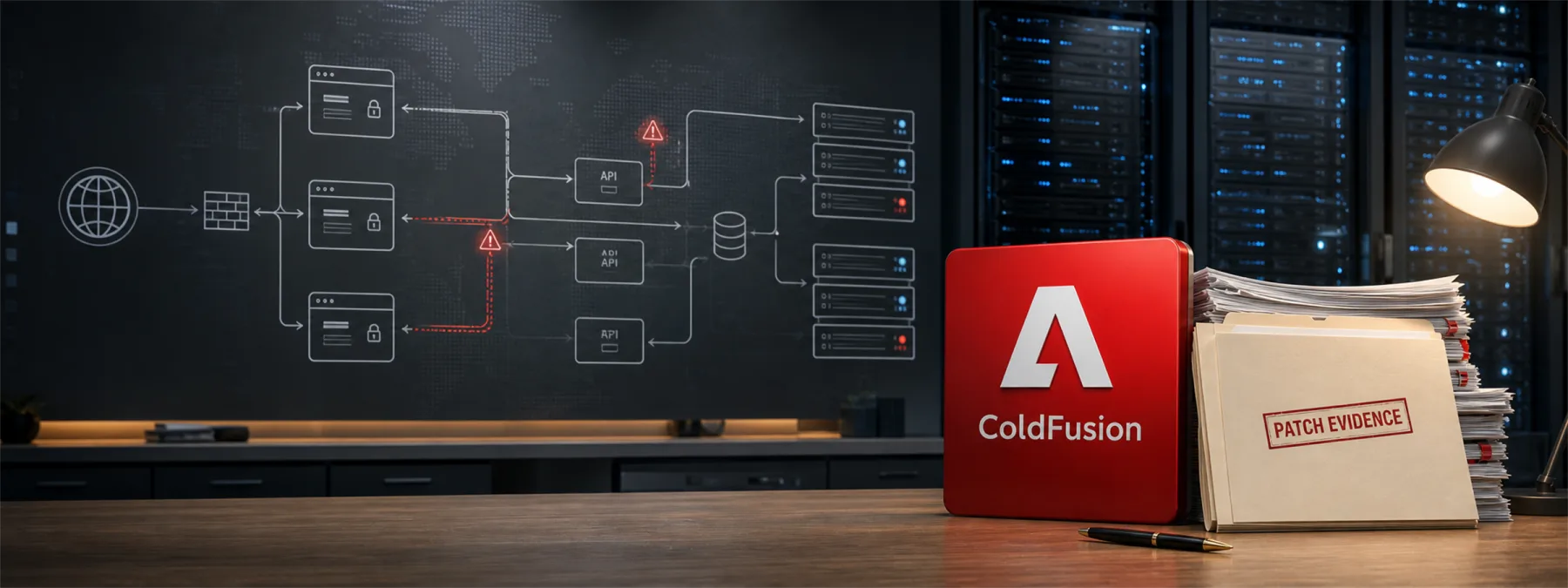
BleepingComputer reported on July 6, 2026 that attackers are exploiting CVE-2026-48282, a maximum-severity Adobe ColdFusion vulnerability. Adobe's security bulletin for ColdFusion 2025 and 2023 listed priority 1 updates on June 30, and Canada's Cyber Centre later said open-source reporting indicated exploitation.
For many business owners, the key issue is not whether they personally use ColdFusion every day. It is whether an older public website, customer portal, intranet, marketing application, or industry system still depends on it somewhere behind the scenes. Web application platforms can stay in production for years after the person who approved them has moved on.
The business risk is hidden ownership
ColdFusion is used to build and run server-side web applications. When a flaw like CVE-2026-48282 reaches active exploitation, the practical question becomes simple: who knows whether the business has exposure, and who is responsible for closing it?
That answer may sit with a website developer, hosting provider, MSP, software vendor, internal IT person, or a contractor who only touches the system when something breaks. If ownership is unclear, patching can turn into an assumption instead of a documented action.
Owners do not need to become ColdFusion administrators. They do need enough evidence to know that a public-facing business system is not being left open because everyone thought someone else handled it.
What to ask the provider
If your business runs custom web applications, portals, legacy intranet tools, or vendor-hosted systems, ask the responsible provider for a short written answer:
- Do any public or internal systems we use run Adobe ColdFusion 2025, ColdFusion 2023, or older ColdFusion versions?
- If yes, which server, application, vendor, or hosting account owns that installation?
- Has the system been updated to the fixed ColdFusion release or otherwise removed from exposure?
- Was the server internet-facing at any point after the June 30 Adobe bulletin?
- What logs or monitoring were reviewed for suspicious access after the exploitation reports?
- Who will confirm that related Java, connector, and lockdown guidance has also been reviewed?
The point is not to bury the provider in paperwork. The point is to replace vague comfort with patch evidence. A ticket that says "updated" is better than a verbal assurance, but a ticket with version numbers, dates, affected hosts, and log review notes is better still.
Why this matters beyond Adobe
This story is also a useful test of web application inventory. Many businesses know their laptops, phones, and Microsoft 365 accounts better than they know the stack behind a website or portal. That gap matters because attackers often look for exposed servers that are old, specialized, or outside the normal endpoint-management process.
A New Jersey business with a customer portal, online intake form, dealer login, patient form workflow, or vendor-facing application should know who patches the platform, who approves emergency maintenance, and how quickly the provider responds when a critical advisory turns into exploitation.
A practical next step
Ask for a one-page web application exposure review. It should list the major public-facing applications, the hosting location, the platform or framework, the patch owner, the last security update date, and the escalation contact for emergency advisories.
If the provider cannot answer quickly, that is useful information. It may mean the business needs a better asset list, clearer vendor terms, or a more direct patch-notification process. The exploit is the news hook; the durable lesson is that patch accountability works best when it is documented before the clock starts ticking.
Sources and further reading