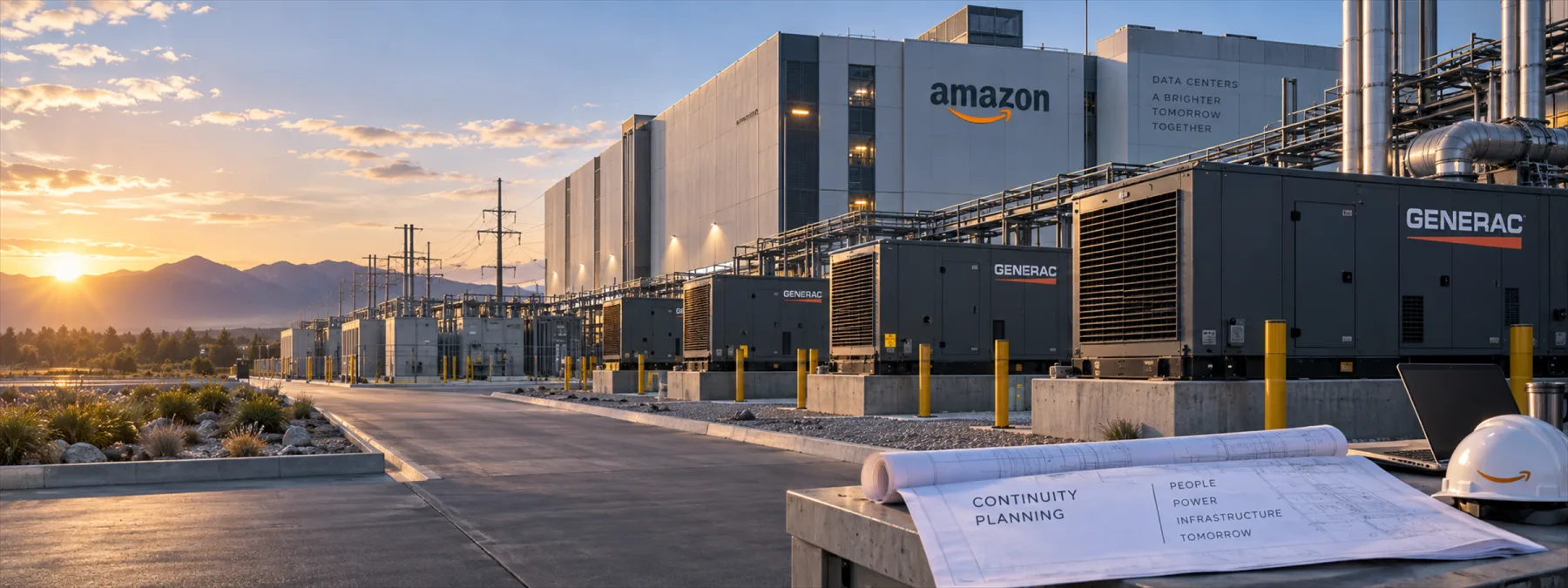
Generac disclosed a major agreement tied to Amazon data centers, and the numbers are large enough to make the physical side of cloud computing hard to ignore. In a September 16, 2026 SEC filing, Generac said it issued a warrant to an Amazon subsidiary and entered a long-term supply agreement for backup power generators for Amazon data centers. Initial deliveries are expected to total $2.4 billion in 2027 and 2028, with warrant vesting tied to aggregate generator payments up to $8 billion.
That is not just a Wall Street story. It is a plain reminder that the cloud is not weightless. AI tools, SaaS platforms, hosted backups, file systems, websites, phone systems, and customer portals all depend on data centers that need power, cooling, hardware, network paths, contracts, and recovery plans.
Why this matters to business owners
Most New Jersey businesses are not negotiating hyperscale generator contracts. They are, however, approving more cloud services and AI-enabled workflows every year. When a vendor says a service is resilient, the useful question is not whether the word appears in a brochure. The useful question is what that resilience actually rests on.
Data center backup power is one part of that answer. So are regional redundancy, failover design, support escalation, recovery objectives, contract terms, and the customer's own fallback process. The Generac Amazon generator deal puts a spotlight on a basic owner-level truth: business continuity is partly a technology decision and partly a vendor-evidence decision.
The business decision behind the headline
AI data center power demand is becoming a planning issue, not only an engineering issue. If a business is moving more work into AI platforms, hosted line-of-business systems, cloud backups, or SaaS applications, leadership should know which processes can pause and which ones cannot.
A business does not need a map of every data center behind every tool. It does need a practical understanding of dependency. Payroll, scheduling, customer communications, accounting, patient or client records, production workflows, and identity systems deserve different levels of scrutiny than a nice-to-have reporting dashboard.
Questions to ask your provider or vendor
- Which services are truly critical? Ask your IT provider to separate core operations from convenience tools.
- Where is the vendor's continuity proof? Look for documented recovery targets, status-history transparency, support commitments, and incident communication practices.
- What happens if the cloud service is unavailable? Define the manual or alternate process before an outage, not during one.
- Are backups independent from the system they protect? A cloud backup that depends entirely on the same identity, region, or vendor account may not be enough.
- Who owns escalation? Decide who opens tickets, who contacts the MSP or vendor, and who tells staff what to do next.
- Does the renewal match the risk? Before renewing a major cloud or AI platform, ask whether the contract and support tier fit the business impact of downtime.
A practical next step
Pick three systems your business would struggle to operate without for a full workday. For each one, ask your provider for the current continuity plan, backup evidence, recovery target, vendor support path, and staff fallback procedure. If those answers are vague, that is the work.
The point is not to panic about every cloud dependency. The point is to make cloud continuity planning visible enough that owners can approve the right spending, reject fuzzy promises, and know which vendor claims deserve proof. Forecasts are nicer when the backup power is not a surprise line item.
Sources and further reading