You have probably already heard about the public disaster Bricks & Minifigs has created for itself. If not, you may be juggling a busy life, which is reasonable. For context, start with Reckless Ben's first video on the subject: I tracked down the thief who stole $200,000 of LEGO. Then come back to the business lesson, because this story is about more than toy bricks and internet outrage.
The viral Bricks & Minifigs controversy has been covered as a strange mix of collectibles, franchise operations, lawsuits, YouTube attention, and public backlash. KATU described the Oregon dispute as involving an alleged consignment arrangement for a valuable LEGO collection, while Bricks & Minifigs has publicly said the matter involved a former franchisee and disputed several claims. Techdirt and GamesRadar have also covered the wider online and legal fallout.
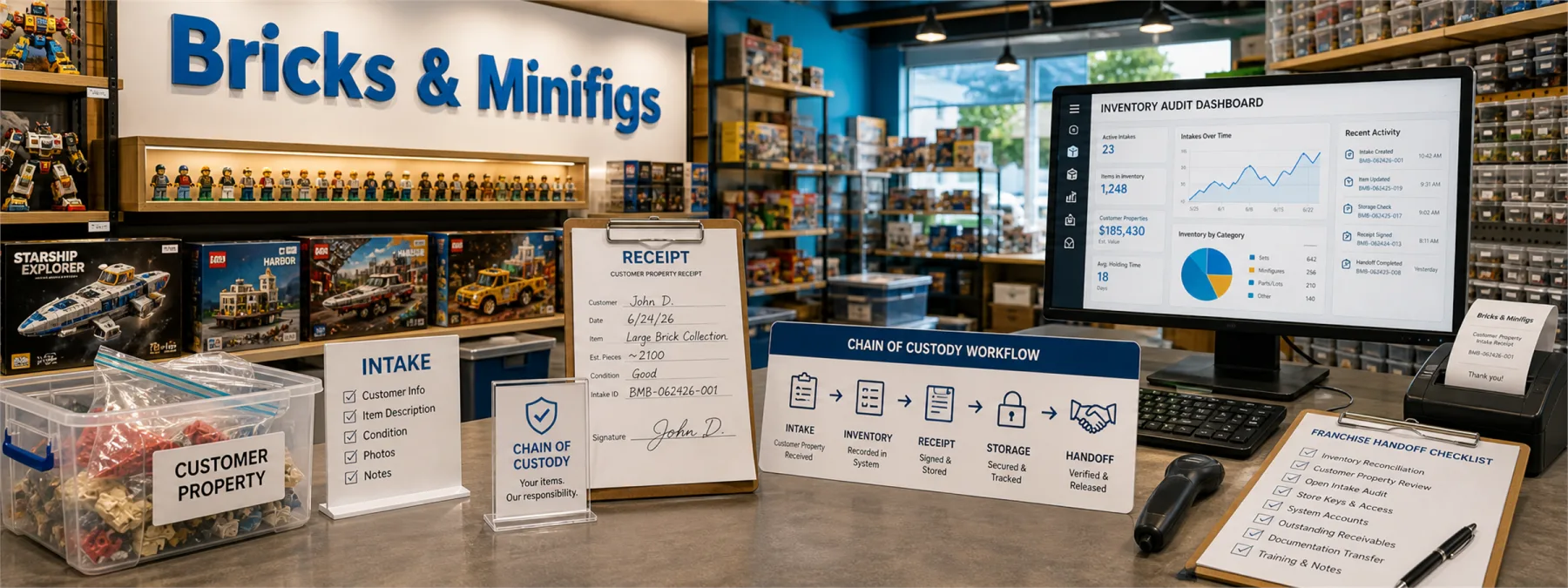
Tekmyster does not need to decide who is right in a disputed legal matter to see the business lesson. When a company accepts valuable customer property, the business needs more than trust, memory, and scattered messages. It needs records that can prove what came in, who approved it, where it went, who had access, what changed, and what was communicated.
The Real Issue For Owners Is Chain Of Custody
For many small and mid-sized businesses, inventory systems are built around normal sales. They may track products bought by the business, items sold at the register, and stock on hand. Consignment, repair intake, storage, rentals, loaner equipment, customer-owned devices, deposits, and estate collections can fall into a gray area if the system was never designed to prove custody.
That gray area becomes dangerous when ownership changes, staff leave, a franchise transfers, a customer questions the status of an item, or a dispute becomes public. At that point, the owner needs evidence, not assumptions. A box of bricks should not require a brick-by-brick courtroom build.
What Should Be Documented
Any business that handles customer-owned property should be able to answer a few basic questions quickly. What exactly was received? Who received it? Was there a signed agreement? Were photos taken? Was the item tagged or serialized? Was its condition recorded? Was it moved, sold, returned, damaged, or transferred? Who approved each step?
The same applies to digital records. A point-of-sale note is useful only if it is tied to a customer record, protected from quiet edits, backed up, searchable, and retained long enough to matter. Email threads, text messages, camera footage, signed forms, payment records, inventory exports, and access logs should not live in disconnected places that only one employee understands.
Franchise And Multi-Location Businesses Need A Handoff Plan
The Bricks & Minifigs story is especially relevant to franchise and multi-location operators because ownership and responsibility can be split across local stores, former owners, corporate policies, and brand reputation. A customer usually does not care which internal entity owns the problem. They care whether the business can explain what happened and make it right.
That requires a formal handoff process. Before a location changes owners, closes, reopens, or changes systems, leadership should verify open customer property, pending consignments, unresolved credits, vendor obligations, active accounts, shared inboxes, admin access, camera retention, and backups. If those records are incomplete, the transition is not operationally clean.
Questions Business Owners Should Ask Now
- Do we ever hold customer-owned property, equipment, documents, media, or inventory?
- Can we prove what came in, when it came in, who accepted it, and under what terms?
- Can inventory, POS, CRM, email, camera, and payment records be connected during a dispute?
- Do managers and employees have individual logins, or are shared accounts hiding accountability?
- Are edits, deletions, refunds, transfers, and returns logged with user names and timestamps?
- Do we have a documented process for ownership changes, location closures, or system migrations?
These are not only legal questions. They are technology and operations questions. If the systems cannot produce a clear timeline, the business may be stuck trying to reconstruct facts after customers, employees, lawyers, and the internet are already involved.
A Practical Next Step
Start with one workflow that involves customer property. Map how the item enters the business, how it is labeled, how records are stored, who can modify them, how status is communicated, and how the item leaves the business. Then test whether a manager could reconstruct the full story without asking the original employee what they remember.
If the answer is no, the fix may involve better intake forms, required photos, serialized tags, POS or inventory configuration, retention settings, role-based access, shared mailbox controls, camera policies, backups, or a handoff checklist. The goal is simple: when trust is questioned, the business should have receipts.
Sources and further reading
- I tracked down the thief who stole $200,000 of LEGO
- How a $200,000 LEGO collection sparked a national internet frenzy
- A Note to Our Community about the Bricks & Minifigs Salem, OR Store
- And Now Basically Everyone In This LEGO Dispute Looks Sketchy
- How this Lego Star Wars collection ignited an online meltdown involving Bricks and Minifigs