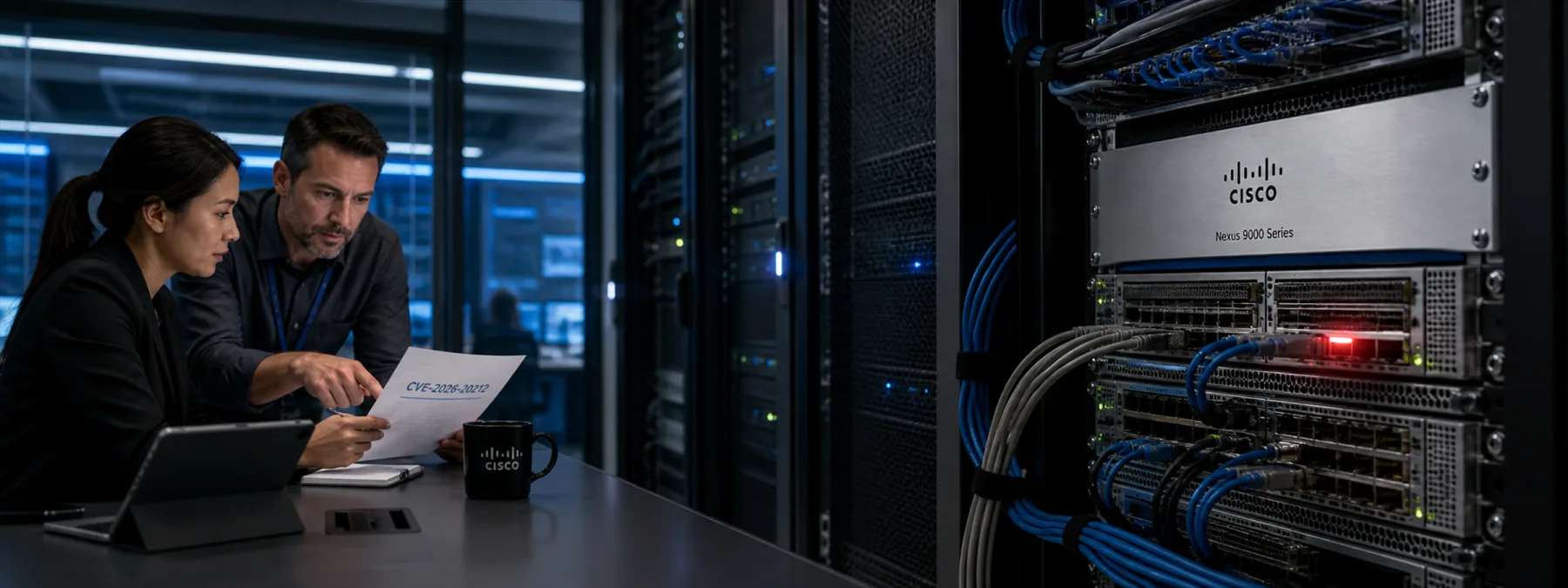
Cisco published a critical security advisory on September 2, 2026 for CVE-2026-20212, a remote code execution vulnerability affecting certain Cisco Nexus 9000 Series switches that include a Silicon One ASIC. Cisco says the flaw can allow an unauthenticated remote attacker to execute code with root privileges if the attacker can reach TCP ports 43210 or 43211 on an affected device.
That sentence sounds like network-engineer territory, but the business issue is broader. Core switches, data center switches, and aggregation switches are often treated as background infrastructure until a security advisory turns them into a board-level continuity question. If a business cannot quickly say which models it owns, who manages them, what networks can reach their control plane, and when fixed software can be installed, the risk is not only technical. It is operational.
The risk is not only the Cisco patch
Cisco rated the Nexus 9000 issue critical with a CVSS base score of 9.8. The advisory says exploitation could allow root-level code execution and could also crash the S1HAL process, causing the device to reload. Cisco also says it is not aware of public malicious use of this vulnerability as of publication.
That last detail matters. A no-known-exploitation statement should reduce panic, not reduce urgency. The practical window is the time between a vendor publishing details and an organization proving whether it is exposed. For many New Jersey businesses, especially medical offices, manufacturers, professional services firms, nonprofits, and schools, the question is not whether the owner can read an NX-OS advisory. The question is whether someone is accountable for translating that advisory into a tested action plan.
Where owner accountability begins
The Cisco Nexus 9000 vulnerability gives owners a useful way to test the quality of network management. A good answer is specific: affected hardware was checked, software versions were reviewed, management access was tested, temporary controls were evaluated, and a change window was proposed. A weak answer sounds more like, "we have Cisco covered," without evidence.
This is especially important when network equipment is handled through a managed service provider, a project vendor, a carrier, or a one-time installation partner. Switches can stay in place for years after the original project is complete. Documentation may live in a ticketing system, a spreadsheet, a vendor portal, or one person's memory. That is not a great place for critical infrastructure to hide.
Questions to ask your IT provider
- Do we have any affected Cisco Nexus 9000 models? Cisco listed specific product identifiers in the advisory. Ask for the inventory evidence, not just a general yes or no.
- Can untrusted networks reach TCP ports 43210 or 43211? The advisory points to those ports as the exposure path. The answer should include how access was tested or filtered.
- Are infrastructure ACLs or Cisco Live Protect appropriate here? Cisco describes temporary mitigation options, but they need to be evaluated against your environment before deployment.
- What fixed NX-OS release applies to our devices? The provider should use Cisco's fixed software guidance or Software Checker and confirm support entitlement if downloads require a Cisco contract.
- When is the change window, and what is the rollback plan? Network patching can affect business operations, so timing, backups, configuration exports, and recovery steps should be documented before the work starts.
A practical next step
Ask for a short network exposure review focused on management access and core switching. It should list network device models, software versions, vendor support status, management interfaces, permitted admin sources, and any high or critical vendor advisories that still need action. Keep it plain enough that a business owner can understand the decision without becoming the network engineer.
The point is not to chase every advisory with a fire drill. The point is to make sure a serious Cisco NX-OS issue becomes a controlled business decision: confirm exposure, apply temporary restrictions if needed, schedule the fixed software, and keep written evidence that the work was completed. Network switches may run quietly, but they should not run anonymously.
Sources and further reading