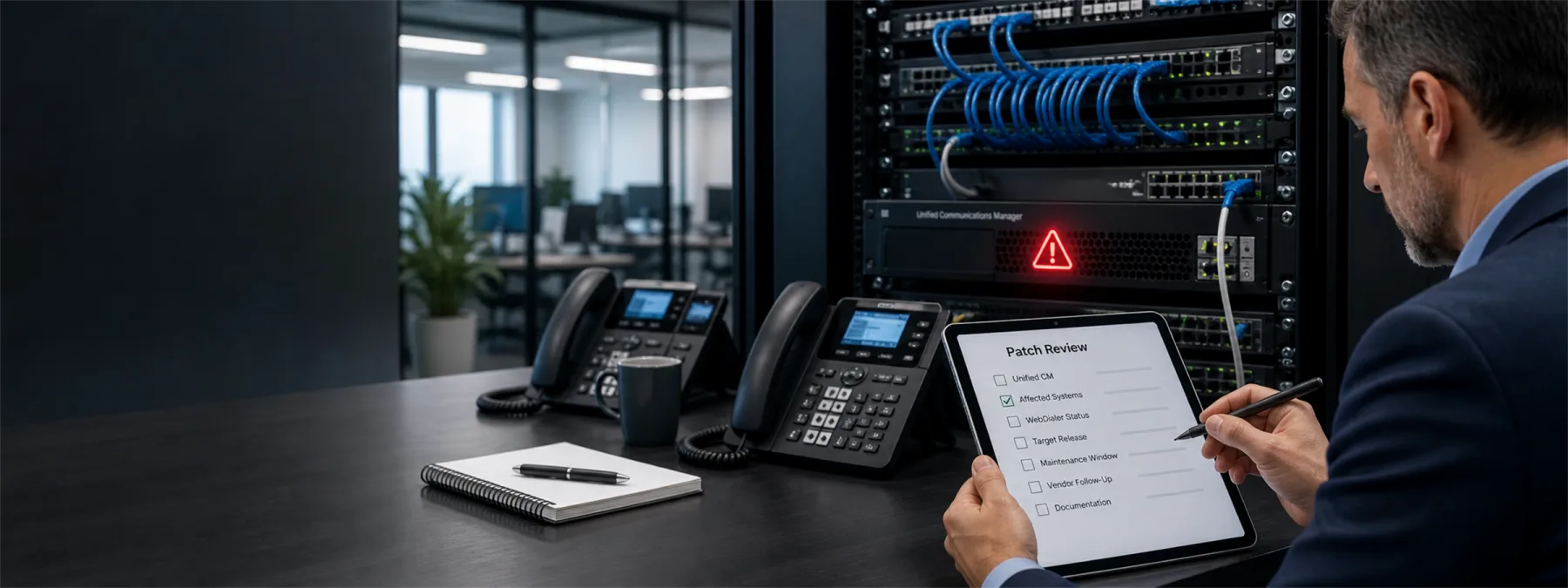
SecurityWeek reported on June 4, 2026 that Cisco released fixes for CVE-2026-20230, a server-side request forgery vulnerability affecting Cisco Unified Communications Manager and Unified Communications Manager Session Management Edition. Cisco's advisory says proof-of-concept exploit code is available, that WebDialer must be enabled for exposure, and that Cisco was not aware of malicious use when the advisory was published.
For business owners, the practical issue is not the acronym or the CVSS score. It is whether anyone can prove what phone-system platform the organization uses, whether the affected service is enabled, what release is running, and who owns the patch plan.
Phone systems are still business infrastructure
Many offices treat voice platforms as a vendor-owned utility. Calls work, extensions ring, and the system sits in the background until there is an outage, a licensing change, or a hardware replacement. That habit can create a blind spot when the phone system is actually a server, appliance, cloud-connected platform, or managed service with its own software lifecycle.
Cisco's advisory says the issue affects Unified CM and Unified CM SME and that the WebDialer service is disabled by default. That does not mean every organization is safe. It means the right answer depends on the local environment, the configuration, and the support arrangement. A business owner should not have to guess.
The decision is who verifies exposure
This kind of advisory creates an owner-level decision: who is responsible for checking the communications environment and documenting the answer?
That may be the internal IT team, an MSP, a phone vendor, a network consultant, or a larger service provider. The name matters less than the proof. If the business depends on the system for customer calls, dispatch, billing, patient scheduling, front-desk workflows, school offices, or nonprofit operations, then the answer should be written down.
A reasonable response does not have to create panic. Cisco said it was not aware of malicious use of this vulnerability at publication time. But proof-of-concept code changes the conversation because it can shorten the time between disclosure and real testing by attackers or opportunistic scanners.
Questions to ask your IT or phone provider
Business owners and office leaders should ask their IT provider, MSP, phone vendor, or internal team for plain answers to these questions:
- Do we use Cisco Unified CM or Cisco Unified CM SME anywhere in our environment?
- If yes, what version or service update is currently running?
- Is the WebDialer service enabled, and who approved that configuration?
- Is the affected system reachable only from trusted internal networks, or is any management or user-facing access exposed more broadly?
- Which Cisco fixed release or patch path applies to our version?
- When will the update be applied, and what outage window is required?
- What rollback or support plan exists if the update affects calling, voicemail, contact center functions, or other workflows?
- How will the provider prove the system was checked and remediated?
The most important answer is not a broad reassurance such as "we monitor Cisco advisories." The useful answer names the system, the release, the service setting, the remediation path, and the person or vendor accountable for completion.
What to document before accepting the answer
For a smaller organization, documentation can be simple. Ask for the platform name, version, affected-service status, patch decision, target date, completion date, and any business impact such as a scheduled reboot or after-hours maintenance window.
If the provider says the business is not affected, ask why. The answer should be specific enough to stand up later: the product is not used, the vulnerable service is disabled, the fixed release is already installed, or the system is covered by a hosted service where the provider can confirm remediation.
This is also a good moment to review who owns phone-system inventory. Business leaders often know who handles laptops and Microsoft 365 but are less certain who owns call-control systems, voicemail platforms, analog gateways, paging integrations, door phones, or emergency-call routing. Those systems matter during normal work and during an incident.
A practical next step
Create a short communications-system review record. List the business phone platform, support vendor, current software version, remote-access method, critical integrations, backup or failover arrangement, and patch-review owner. Then add this Cisco advisory check to the next vendor or MSP review.
The goal is not to turn a business owner into a Cisco engineer. The goal is to make sure that a critical system has an owner, a patch path, and a written answer before the next phone-system problem becomes urgent.
Sources and further reading