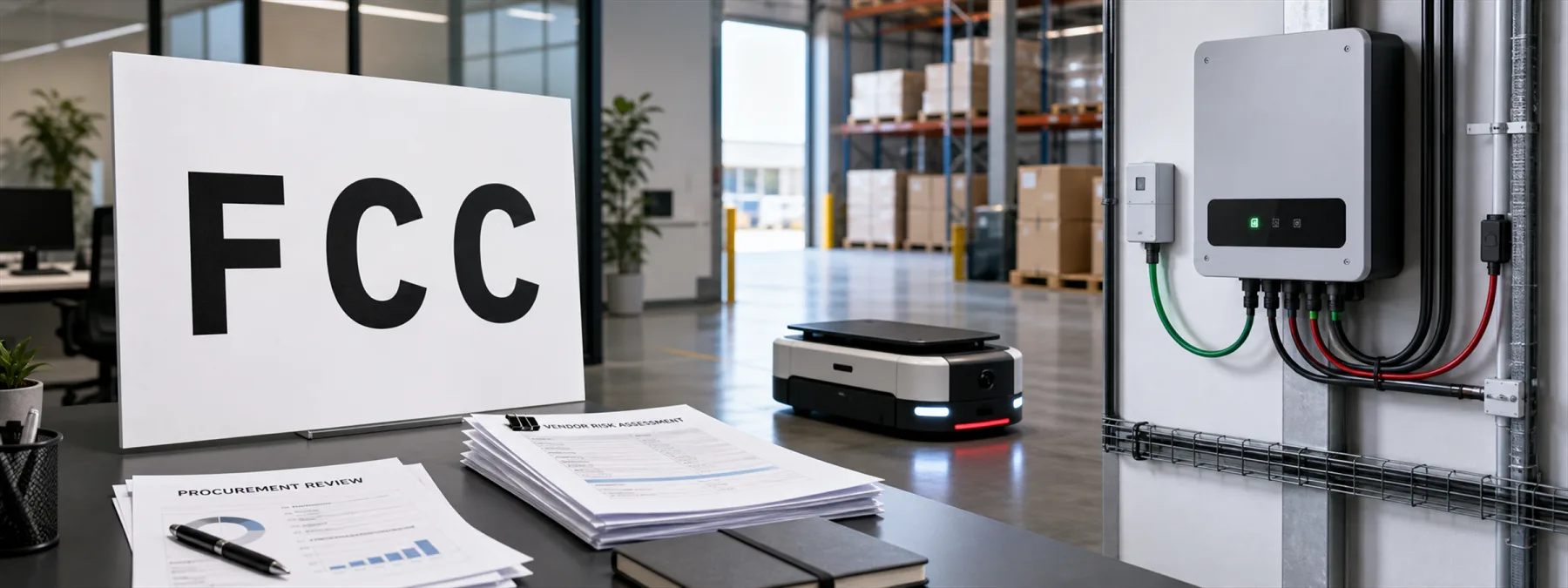
Same-day reporting on July 30 covered a Federal Communications Commission action that may sound far away from the average office, warehouse, school, nonprofit, or manufacturing floor: the FCC added foreign-produced advanced robotic devices and connected power inverters to its Covered List. In plain English, certain new connected robots and power inverters may not be able to receive the equipment authorization needed for import, marketing, or sale in the United States.
This is not a reason to panic over every device already sitting in a closet, on a roof, in a cleaning cart, or near an electrical panel. The FCC fact sheet says previously purchased devices and previously authorized models are not affected by the action. The better takeaway is more practical: connected operational equipment now deserves the same vendor-risk review many owners already apply to software, security cameras, routers, and cloud services.
Why this matters beyond robots
The affected categories are easy to underestimate because they often arrive through non-IT budgets. A facilities team may evaluate a robotic cleaning device. A warehouse may look at mobile automation. A contractor may recommend a power inverter for solar, battery, or electrical infrastructure. A school, medical office, or local business may see the purchase as equipment first and technology second.
That distinction is getting thin. The FCC's fact sheet points to remote connectivity, data collection, monitoring, sensing, and control as part of the concern. The agency also described supply-chain and cybersecurity risks to critical infrastructure. Whether an owner agrees with every policy choice or not, the business lesson is useful: if a device connects to a network, accepts remote updates, talks to a vendor cloud, collects environmental data, or controls physical operations, it belongs in the technology review.
The business decision
The decision is not simply whether a product is allowed today. Owners need to know whether the equipment will remain supportable tomorrow. If a vendor says a robot, inverter, controller, or smart device is safe to buy, the owner should ask for evidence that the specific model is authorized, that firmware and security updates are available, and that future replacement units will not create a procurement surprise.
This matters for New Jersey businesses that rely on contractors and resellers. The person selling the device may not be the manufacturer, the cloud operator, the firmware maintainer, or the party responsible when remote access changes. That creates a familiar accountability problem: everyone can sound confident during the sales process, but the owner is left with the operational risk when a device cannot be replaced, patched, serviced, or documented.
Questions to ask before approval
- Is this exact model FCC-authorized for sale and use in the United States? Ask for the model number, authorization documentation, and any limitations that apply.
- Where is the device produced, assembled, and supported? The answer should be specific enough to evaluate supply-chain risk, not just a brand name on a quote.
- What cloud services or remote access does it require? Confirm whether the device can operate safely if vendor cloud access is interrupted, restricted, or discontinued.
- How are firmware and security updates handled? Ask who approves updates, how emergency patches are delivered, and whether updates require vendor access into the network.
- What data does the device collect? For robots, sensors, cameras, mapping, audio, location, and operational telemetry can matter. For inverters, monitoring and control data can matter.
- Who owns replacement planning? If a model becomes unavailable, restricted, or unsupported, the business needs a documented path before the purchase order is signed.
A practical next step
For existing connected equipment, start with an inventory. Include vendor, model, location, network connection, remote-access method, update process, cloud dependency, and renewal or warranty date. This does not need to become a giant research project on day one. Even a simple list can reveal devices that facilities, operations, and IT have been treating as someone else's problem.
For new purchases, add a connected-equipment review step before approval. If the device touches the network, uses a vendor portal, controls power, moves through a worksite, stores mapping data, or depends on remote support, it should not be approved on price and features alone. A good vendor should be able to explain authorization, support, security updates, and replacement options without making the owner decode a policy bulletin.
The FCC story is a useful nudge because it turns a technical rule into a business habit. Connected equipment may look like hardware, but the risk travels through software, vendors, networks, cloud services, and contracts. That means the approval process needs more than a spec sheet.
Sources and further reading