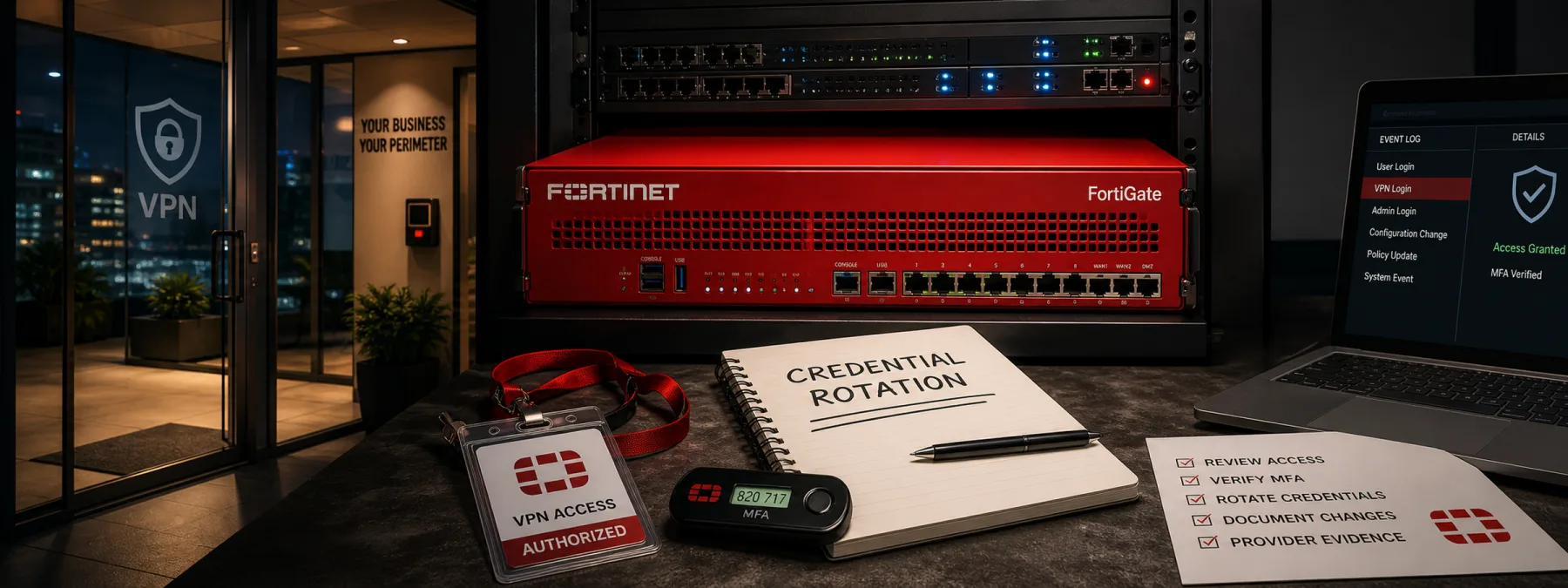
Fortinet published guidance on June 19, 2026 after reports that malicious actors targeted Fortinet devices in a credential-harvesting campaign known as FortiBleed. The company says its initial analysis points to credential reuse from previous incidents and brute-force activity against devices with weak password hygiene and no multifactor authentication, not a new Fortinet vulnerability.
That distinction matters, but it does not make the business decision smaller. A firewall or VPN appliance is often the front door to a company's network. If credentials tied to that door may have been exposed, an owner needs more than a quick assurance that the device is patched.
CISA's related alert urges affected FortiGate and SSL VPN customers to terminate active sessions, reset VPN and administrative passwords, enable phishing-resistant MFA, review logs, move administrator credential storage to stronger PBKDF2-backed handling, and reduce public management exposure. SOCRadar, which updated its FortiBleed analysis on June 19, reported a verified database of compromised FortiGate credentials across many countries and sectors.
For New Jersey businesses, healthcare practices, schools, nonprofits, manufacturers, and professional services firms, the practical question is simple: who can prove that the firewall front door was checked, not just discussed?
The Risk Is Credential Control
Many owners never log in to their firewall. The device may be installed by an MSP, supported by a security vendor, or handled by a part-time IT consultant. That is normal. It also means the owner may not know whether old VPN accounts still exist, whether administrator passwords were reused, whether external management is exposed, or whether MFA covers every privileged path.
Fortinet's guidance points to exactly that kind of operational gap. Credential reuse, weak password hygiene, old password storage behavior, and missing MFA are not exotic problems. They are everyday governance problems that happen when no one owns the boring maintenance after installation.
This is why the response should not stop at firmware version. Patching matters, but credentials, sessions, logs, accounts, and management exposure matter too. A device can be current and still carry risky accounts, stale passwords, or public access that no longer makes business sense.
Questions for the IT Provider
- Do we use Fortinet FortiGate firewalls or SSL VPN gateways anywhere in our environment?
- Are any of those devices internet-facing, externally managed, or reachable through vendor access?
- Were all active VPN and administrative sessions terminated after the FortiBleed guidance?
- Were all Fortinet VPN and administrative credentials reset, including shared, vendor, emergency, and service accounts?
- Is phishing-resistant MFA enforced for every administrator and VPN user account?
- Were firewall, VPN, authentication, and domain controller logs reviewed for suspicious access, lateral movement, or unauthorized configuration changes?
- Were device configurations checked for unexpected users, password resets, policy changes, or newly exposed management interfaces?
- Are administrator credentials stored with supported stronger hashing behavior after the relevant FortiOS updates and login changes?
- Can the provider give a dated summary of what was checked, changed, and still needs follow-up?
What Proof Should Look Like
The useful answer is not a long technical report. A short written note is enough if it is specific. It should name the Fortinet devices in scope, identify who manages them, confirm whether management access is internet-facing, list the credential and MFA actions completed, summarize the log review window, and note any open remediation items.
If the provider says no Fortinet devices are in use, ask for the same style of review for whatever firewall and VPN platform protects the business. The brand may change, but the business problem stays the same: perimeter devices need account ownership, credential hygiene, management restrictions, and evidence after a public security event.
Owners do not need to become firewall engineers. They do need enough documentation to know whether the people managing the front door checked the keys, locks, camera footage, and spare access codes. That is the difference between a security update and accountable risk management.
A Practical Next Step
Ask your IT provider for a Fortinet/FortiGate exposure note by device or site. If your business uses another firewall platform, ask for a similar perimeter-access review. The request should cover credential resets, MFA, active sessions, unauthorized accounts, log review, firmware and password-storage status, and whether management access is locked down to trusted sources.
The point is not to turn every advisory into a crisis. The point is to make sure the systems protecting the business do not become unreviewed assumptions. Firewalls are supposed to reduce risk. They should not become a mystery door with too many old keys.
Sources and further reading
- Analysis of Reported Credential Compromise of FortiGate Devices
- CISA Urges Hardening Fortinet Devices After Reports of Credential Exposure
- FortiBleed 2026: The Compromise of 86,644 Fortinet FortiGate Firewalls and Credential Leak
- CISA warns Fortinet users to secure devices after FortiBleed leak
- FortiBleed: 86,000 Fortinet Device Credentials Compromised