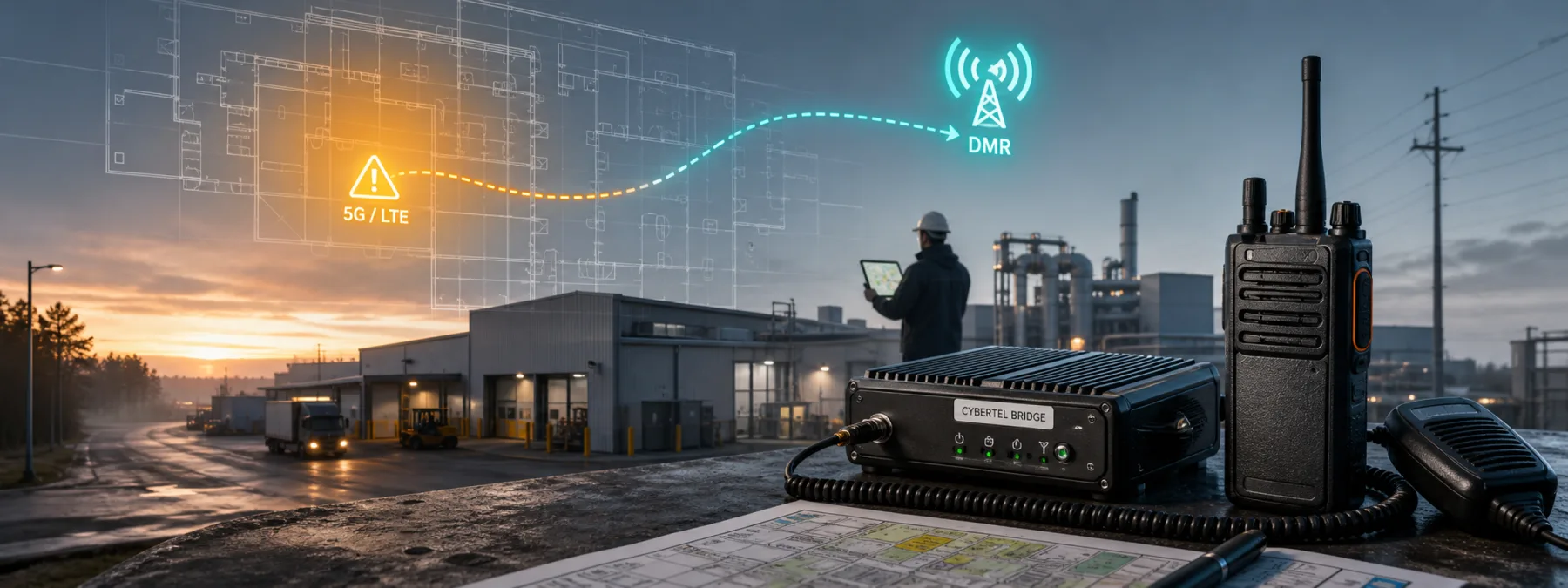
Cybertel Bridge announced a new hybrid communications technology on August 17, 2026, aimed at a familiar operational problem: broadband coverage is useful until the team moves into a basement, remote site, warehouse corner, utility area, or emergency scene where the signal becomes unreliable.
The company's announcement describes an embedded hybrid architecture for its LM75 device platform that combines 5G/LTE Mission Critical Services, 450 MHz connectivity, and DMR Tier II direct mode. In plain English, the goal is to let field communications fall back automatically when broadband coverage is weak, then return to broadband when the network is stable again.
That may sound like a specialized public safety or utility story, but the business lesson is broader. Many organizations now treat mobile connectivity as if it is always there. Facilities teams use mobile apps. Security teams rely on push-to-talk. School administrators coordinate through phones. Healthcare practices and property managers depend on messaging during incidents. Manufacturers, logistics teams, contractors, and nonprofits often have staff working in places where normal coverage is not guaranteed.
Critical communications continuity is an owner issue
Critical communications continuity is not only about buying a different radio or signing a carrier contract. It is about knowing which workflows cannot wait when the network gets weak. If an elevator room, construction site, receiving dock, parking structure, school campus, clinic basement, or remote jobsite has spotty coverage, the business needs more than optimism and a group text.
Cybertel Bridge says its approach can switch communications from MCX broadband service to DMR direct mode when signal conditions fall below the required level. Whether that specific technology fits a given business is a vendor and technical decision. The owner decision is more basic: which people need to reach each other when the usual network is not available, and who has proved the backup path actually works?
That question matters because outages rarely arrive as neat IT tickets. They arrive during weather events, power problems, building incidents, security concerns, public events, equipment failures, or routine work in awkward coverage areas. The business may not need a mission-critical radio system, but it does need a communication plan that matches the real operating environment.
Where broadband assumptions create risk
The weak spot is often the gap between the official plan and the daily workaround. A written emergency procedure may say staff will call, text, or use a mobile app. A vendor proposal may say coverage is available. A team may assume Wi-Fi calling, cellular service, or a cloud system will be enough. None of that answers whether the exact people, devices, locations, permissions, and backup channels have been tested together.
For New Jersey businesses and public-serving organizations, this can show up in ordinary places: a medical office with a bad signal in the records room, a warehouse with dead zones near loading bays, a school event spread across buildings, a property team covering stairwells and mechanical rooms, or a field crew working where one carrier performs better than another.
The risk is not always dramatic. Sometimes it is a delay, a missed handoff, a supervisor who cannot be reached, or a team that abandons the official process because the tool does not work where the work happens. That is still a business problem.
Questions to ask before approving the next communication plan
- Which workflows are coverage-sensitive? Identify the tasks that cannot stop when broadband, Wi-Fi, or a cloud app is unavailable.
- Where are the dead zones? Ask for real coverage testing in the buildings, parking areas, remote locations, and field environments where staff actually work.
- What is the fallback path? Document whether the backup is radio, secondary carrier, satellite, Wi-Fi, a deployable device, an offline procedure, or a manual escalation tree.
- Who owns the test? Assign one owner for communication testing and one owner for vendor evidence. Do not let every provider assume another provider checked it.
- What happens during power loss? Confirm battery life, chargers, generators, device rotation, and how long the communication path can operate without normal power.
- How often is the plan rehearsed? A fallback that has not been practiced is a theory with a monthly bill.
A practical next step
Before approving a new mobile service, radio upgrade, building security plan, emergency procedure, or field operations tool, ask for a simple communications map. It should list the locations, people, devices, carriers or networks, fallback method, testing date, and the person accountable for fixing gaps.
For smaller organizations, that review does not have to become a giant project. Start with the places where communication failure would create the most operational pain: front desk to manager, nurse to administrator, facilities to principal, warehouse floor to supervisor, jobsite to office, security staff to leadership, or dispatch to field crew.
The Cybertel Bridge announcement is a reminder that communication resilience is becoming more layered. Broadband, radios, direct mode, deployable coverage, and vendor-managed services can all have a role. The business value comes from matching the tool to the risk, proving it works, and keeping ownership visible after the invoice is signed.
Sources and further reading