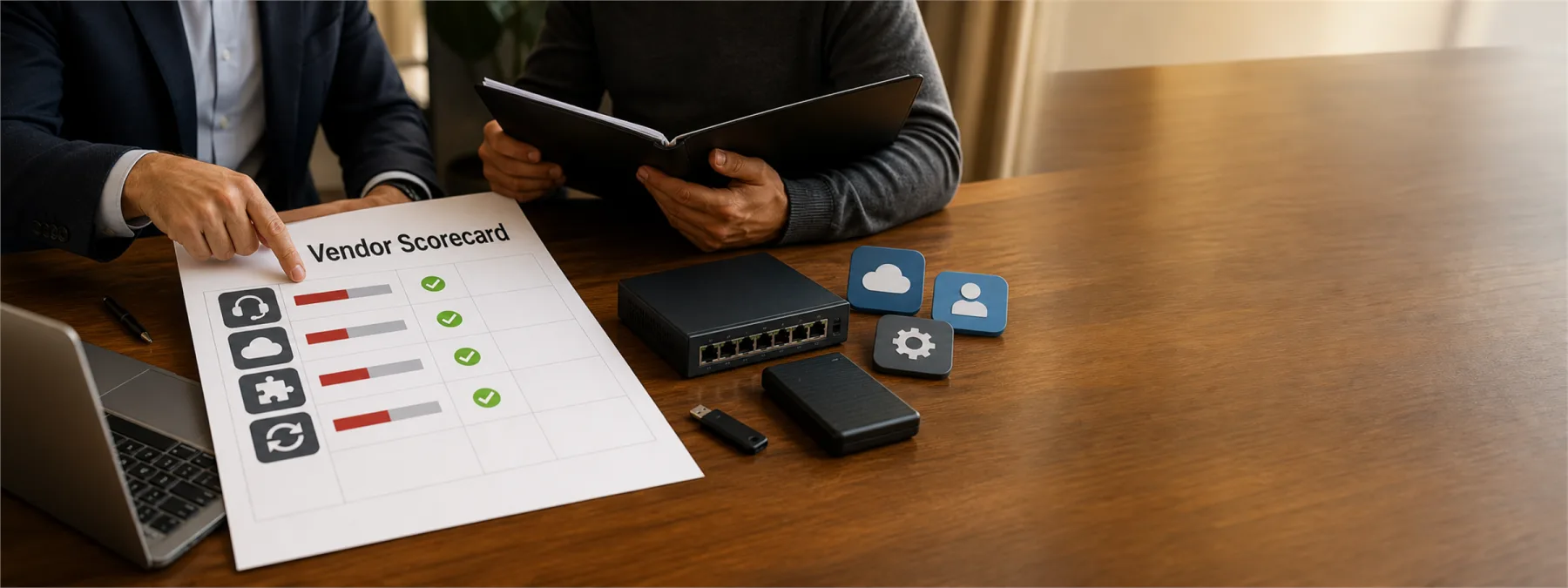
CRN published its 2026 Annual Report Card on August 9, summarizing how North American solution providers graded IT vendors across 23 technology categories. The report looks beyond product names and feature lists, scoring vendors on product innovation, support, partnership, and managed and cloud services.
That matters because most small and midsize businesses do not buy technology in a vacuum. A New Jersey practice, nonprofit, manufacturer, school, or professional services firm usually hears a recommendation through an MSP, consultant, reseller, or internal IT lead. The question is not only whether a product can do the job. It is whether the vendor ecosystem behind it can support the business when onboarding gets messy, licensing changes, a ticket needs escalation, or a recovery plan has to work under pressure.
The buying decision is not only the product
A clean demo can make two vendors look nearly identical. The day-to-day ownership experience is where they separate. CRN's report card categories include areas that owners often feel later: post-sales support, communication, ease of doing business, managed-service readiness, cloud program fit, integration, reliability, and recovery-related capabilities.
That turns an IT vendor report card into a practical buying signal. It does not replace a local assessment, and it does not mean the highest-ranked vendor is automatically right for every company. It does give owners a better set of questions before approving a quote or accepting the default recommendation.
What owners should look at before approval
For business technology vendor selection, the support model deserves as much attention as the feature model. A cheaper tool can become expensive if the provider cannot get answers from the vendor. A popular platform can still be a poor fit if it lacks the integrations, licensing flexibility, or recovery options the business actually needs.
- Support response: How does the MSP get help from the vendor when a critical issue is not solved locally?
- Integration fit: Does the product connect cleanly with identity, backup, monitoring, security, and line-of-business systems?
- Managed services readiness: Can the provider monitor, patch, report, and administer the platform efficiently across clients?
- Recovery expectations: What happens when data recovery, endpoint restoration, firewall replacement, or cloud failover is needed?
- Contract accountability: Which obligations are in the agreement, and which are only implied by sales language?
Questions for the MSP or vendor
Before the next renewal or platform change, owners should ask for a plain-language explanation of why a recommended vendor fits the business. The answer should be specific enough that a nontechnical decision-maker can compare risk, cost, and operational impact.
- What problem is this vendor solving better than the current option?
- What support path will be used if our provider cannot resolve an issue directly?
- Which parts of the environment will this tool touch, and who owns each integration?
- How will we measure whether the vendor is performing after purchase?
- What would make this product a bad fit for our business?
- What is the exit plan if pricing, support quality, or product direction changes?
The last question is often the most revealing. A provider that can explain the exit plan usually understands the operating plan. A provider that cannot may be selling the logo more than the outcome.
A practical next step
Pick one important renewal, security platform, network upgrade, backup service, or cloud tool on the calendar. Ask your IT provider to document the vendor selection logic in one page: business need, alternatives considered, support path, integration dependencies, recovery expectations, contract terms, and measurable success criteria.
That review does not need to slow every project down. It simply puts vendor selection on the same footing as other business decisions. Features get the product into the conversation. Support, accountability, and fit decide whether it belongs in the business.
Sources and further reading