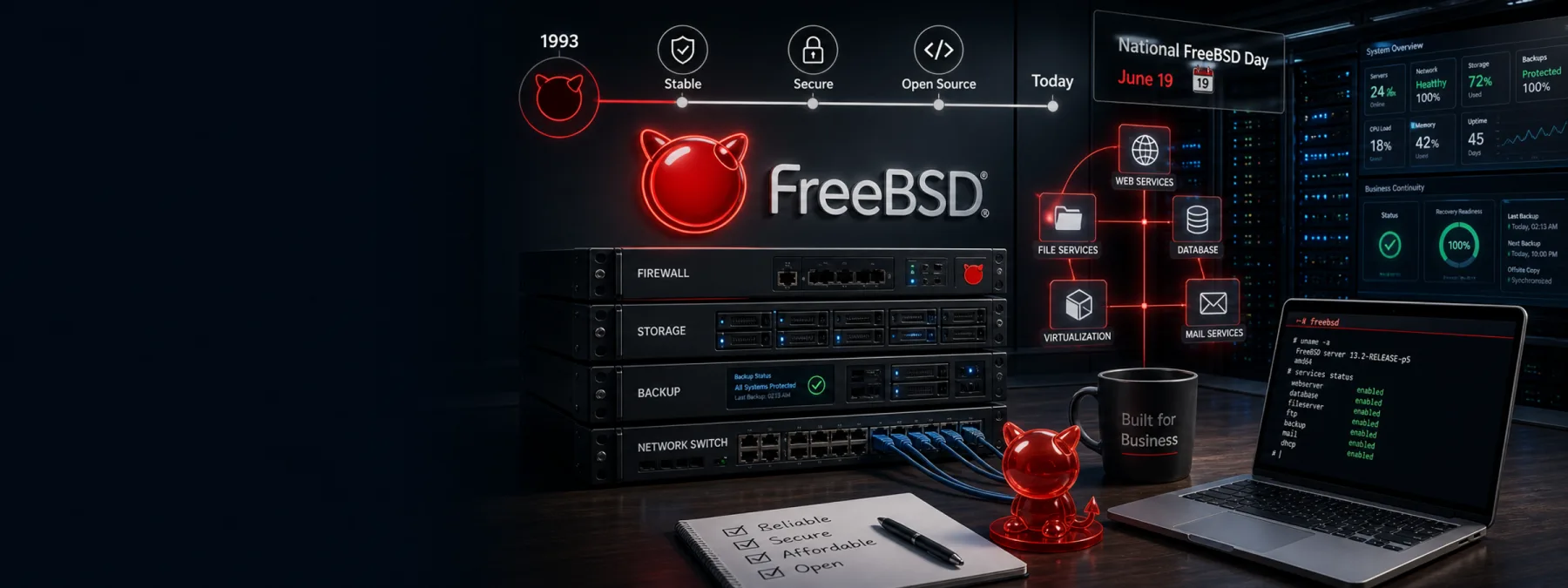
Today, June 19, is National FreeBSD Day. The FreeBSD Foundation says the day commemorates the June 19, 1993 moment when the FreeBSD name was agreed upon for a new open-source UNIX derivative. The first FreeBSD 1.0 general distribution followed later in 1993, and the project has been quietly shaping infrastructure ever since.
Quiet is the key word. FreeBSD is not usually the operating system people argue about at the conference-room table. It is more likely to be under the table, in the rack, inside a firewall, behind a storage appliance, powering a network service, or embedded in a product that a business simply expects to work. In technology, boring often means the good kind of boring.
A Short History With a Long Tail
FreeBSD grew out of the early 1990s BSD and 386BSD community, with the FreeBSD Handbook tracing the project back to work by Nate Williams, Rod Grimes, and Jordan Hubbard. The goal was practical: produce a cleaner, usable, open operating system that could keep moving when earlier patchkit work was no longer enough.
That history matters because FreeBSD has always had a builder's flavor. It is not only an operating system for hobbyists or universities. It has been used to build products, appliances, network platforms, storage systems, high-performance services, and embedded devices. The FreeBSD Foundation points to major technology users and everyday products as examples of how widely FreeBSD code and systems show up.
Why Small and Mid-Sized Businesses Benefit
Most small and mid-sized businesses do not choose FreeBSD directly by opening an installer on a random Tuesday. They benefit from it indirectly through the products and services around them. Firewalls, routers, storage systems, hosting platforms, web services, edge systems, and specialized appliances may use FreeBSD or FreeBSD-derived components because the platform is stable, network-focused, permissively licensed, and well understood by engineers who build infrastructure.
That can matter to an SMB in very practical ways. A stable network appliance reduces downtime. A mature storage platform protects files and backups. A predictable server platform gives vendors a dependable base. A permissive open-source license lets product companies build without turning every deployment into a licensing maze. FreeBSD may not be the face on the invoice, but it can still be part of the reason the system behaves.
The Business Lesson Is Inventory, Not Nostalgia
National FreeBSD Day is a celebration, but it is also a useful prompt. Business owners do not need to become operating-system historians. They do need to know which quiet platforms support the business, who maintains them, and whether those systems are still patched, backed up, documented, and monitored.
The same question applies whether the system is FreeBSD, Linux, Windows Server, a hosted SaaS platform, or a vendor appliance: who owns it after installation? A firewall that has been stable for years can still become a risk if firmware updates stopped, admin access is shared, backups are missing, or no one knows when the support contract expired.
Questions Worth Asking Today
- Which network, storage, firewall, voice, hosting, or appliance systems keep the business running?
- Do any of those systems use FreeBSD, BSD-derived code, or another open-source operating system?
- Who is responsible for updates, configuration backups, monitoring, and support renewals?
- Are old appliances still receiving security updates from the vendor?
- Is there documentation for admin access, replacement steps, and recovery procedures?
- Does the business understand where open-source platforms reduce cost, improve flexibility, or create support responsibilities?
FreeBSD's Quiet Gift to Business
FreeBSD's business value is not that every company should run out and standardize on it tomorrow. The better lesson is that mature infrastructure wins trust by being predictable, maintainable, and useful over a long period of time. That is a pretty good birthday card for an operating system.
On National FreeBSD Day, the practical move is simple: thank the quiet systems, then make sure someone still knows how they work. If the answer is a blank stare, the operating system is not the problem. The ownership model is.
Sources and further reading