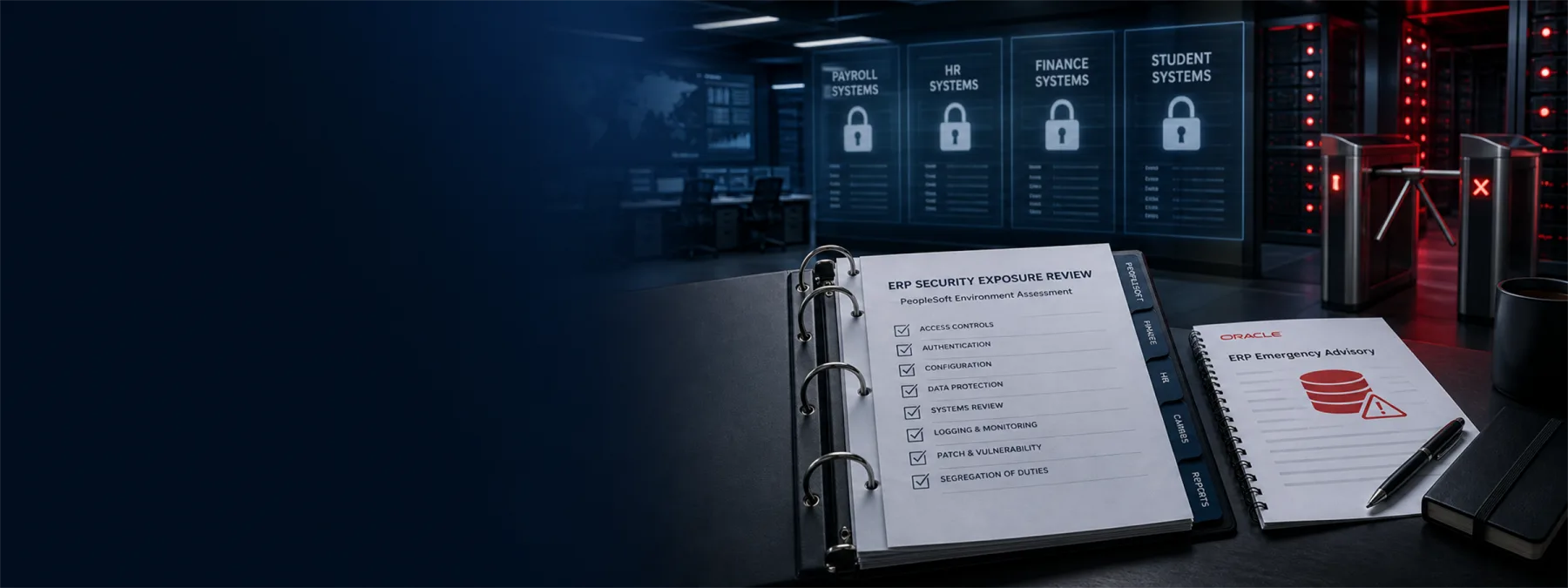
SecurityWeek reported on June 12, 2026 that Google and Mandiant confirmed exploitation of an Oracle PeopleSoft vulnerability tracked as CVE-2026-35273. Oracle's advisory says the flaw affects PeopleSoft Enterprise PeopleTools 8.61 and 8.62, is remotely exploitable without authentication, and may result in remote code execution.
That is not just a technical alert for large IT departments. PeopleSoft and similar ERP platforms often sit behind payroll, finance, HR, procurement, student records, and other core workflows. When a system like that is exposed, the business question is not only whether a vendor advisory was forwarded. The question is whether the organization can prove what was exposed, what changed, and whether anyone checked for signs of compromise.
Why this matters to business and school leaders
Google and Mandiant reported that they notified more than 100 organizations whose IP addresses appeared to correlate with potentially vulnerable endpoints. They said most of those organizations were based in the United States, and 68 percent were in higher education. SecurityWeek also reported that some targets blocked the attack, while others were compromised and had data stolen.
Most small and midsize organizations do not run PeopleSoft themselves. But many depend on the same kind of business-critical software stack: an ERP, student information system, finance system, HR platform, billing system, or specialized line-of-business application that is managed by a mix of internal staff, software vendors, hosting providers, and outside IT firms.
That shared ownership can become a problem during an emergency. One party may assume the vendor owns the fix. Another may assume the MSP has already checked exposure. A department head may hear that a mitigation exists and assume the risk is closed. For leadership, that is not enough.
The decision is about proof, not panic
Oracle said customers should implement the recommended mitigations as a high-priority risk reduction measure. Google and Mandiant's quick guide recommended disabling the Environment Management Hub service where applicable, removing or restricting access to affected PeopleSoft endpoints, and blocking external access to specific paths if the service cannot be disabled.
Those are technical steps, but the owner-level decision is straightforward: require evidence before accepting closure. A closed ticket should explain which systems were in scope, whether the affected PeopleTools versions were present, whether the relevant endpoints were reachable from the internet, which mitigation or configuration change was applied, and who reviewed logs for suspicious activity.
This is especially important for schools, nonprofits, healthcare practices, and professional services firms because operational systems often contain sensitive records that are not obvious from the application name alone. Payroll data, student data, employee files, vendor records, support tickets, and identity details can all live near the systems that keep daily operations moving.
Questions to ask your IT provider or software vendor
- Do we run Oracle PeopleSoft PeopleTools 8.61 or 8.62, or any system dependent on those versions?
- Are any PeopleSoft, ERP, HR, payroll, finance, or student-system endpoints reachable from the public internet?
- Which Oracle mitigation guidance was applied, when was it applied, and by whom?
- If a mitigation could not be applied immediately, what temporary network restrictions were put in place?
- Were logs reviewed for suspicious requests to the affected PeopleSoft paths and for unexpected files, administrative activity, or remote-management tools?
- Who is accountable for confirming that hosted, vendor-managed, and internally managed systems were all checked?
- What written evidence will leadership receive before the incident is considered closed?
A practical next step
If your organization uses PeopleSoft, treat this as an exposure and compromise-review issue, not only a patching issue. Ask for a short written status report that names the affected systems, confirms whether the vulnerable versions were present, states whether internet exposure existed, lists the mitigation or restriction applied, and summarizes the log review.
If your organization does not use PeopleSoft, use this story as a test of your emergency vendor process. Pick your most important ERP, payroll, HR, finance, billing, or student records platform and ask who would own the same review if that vendor released an emergency advisory tomorrow morning.
The answer should not be a vague assurance that updates are automatic or that the vendor handles security. For systems that hold operational records, leadership needs named ownership, clear evidence, and a documented decision trail before accepting that the risk has been handled.
Sources and further reading