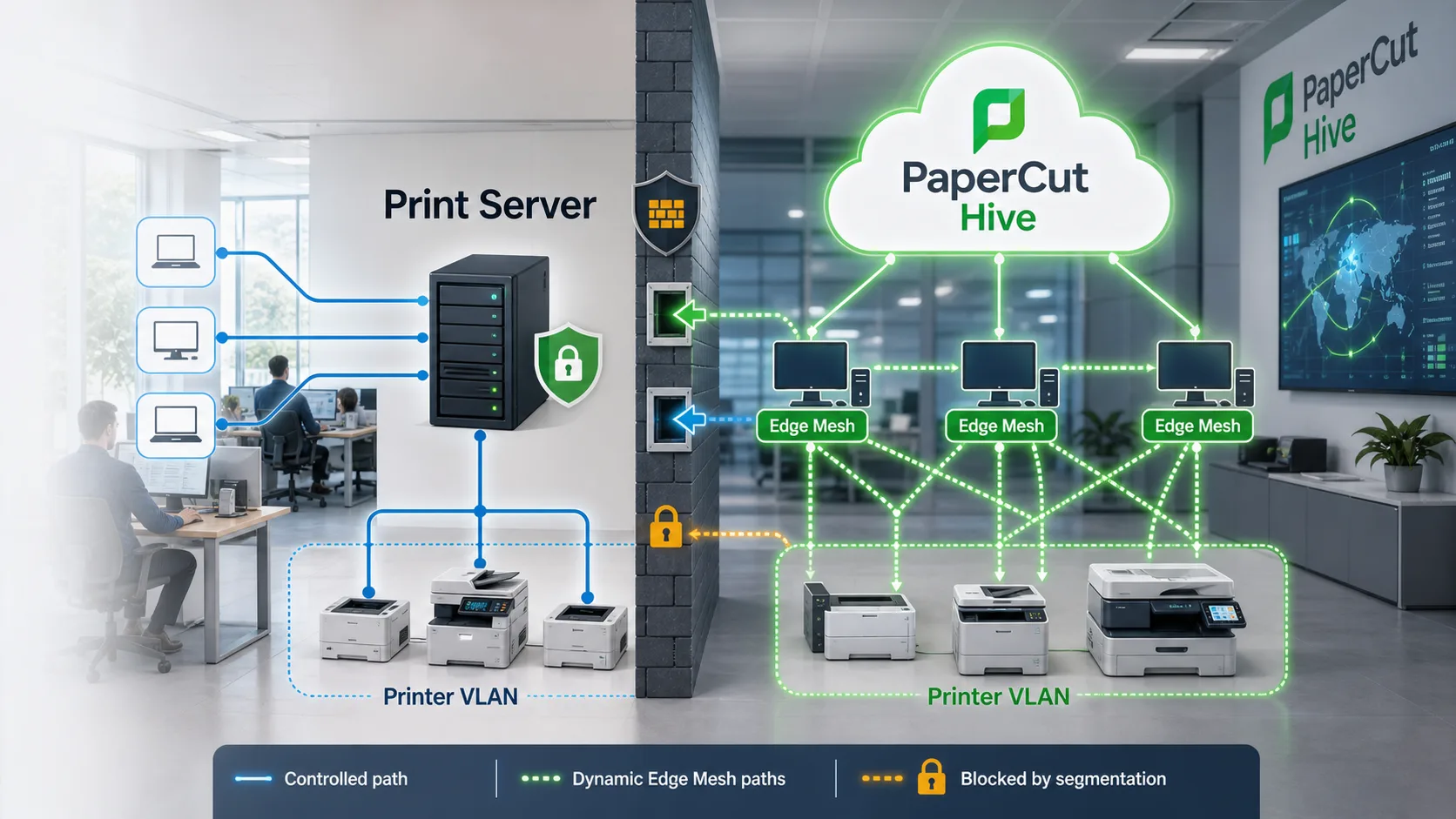
Cloud print management sounds clean on paper. Remove the print server, reduce infrastructure, simplify administration, and let users print from anywhere. That is the promise behind products like PaperCut Hive.
But "serverless" does not automatically mean "more secure." In a segmented business network, it can sometimes mean the opposite.
The issue is not whether PaperCut Hive has security features. The issue is architectural. Hive can require communication paths that a properly segmented print-server environment was designed specifically to avoid.
The Old Model: Printers Stay Behind Print Servers
In a traditional print-server environment, printers can live in their own restricted VLAN. That printer VLAN can be controlled with simple firewall rules: printers talk to print servers, print servers talk to printers, and user devices do not talk directly to the printer network.
That model is simple, boring, and secure. The print server becomes the controlled choke point for print jobs, queue management, driver deployment, access control, and auditing. From a firewall perspective, that is exactly what you want: predictable traffic between predictable systems.
If a wireless laptop is compromised, it should not be able to scan, probe, authenticate to, or send traffic directly toward printers. If a desktop is compromised, it should not automatically become a bridge into the printer VLAN. Segmentation protects both sides.
Printers are not endpoints you should trust broadly. They are embedded devices with firmware, web interfaces, scan-to-email features, address books, stored jobs, and vendor-specific protocols. Keeping them isolated is basic security hygiene.
The Hive Model Changes The Trust Boundary
PaperCut Hive replaces the traditional print-server model with an Edge Mesh architecture. PaperCut describes Edge Mesh as using existing network devices as redundant parts of a collective print server. That is the key difference: instead of concentrating print delivery through a dedicated server, print delivery can be distributed across local edge nodes.
PaperCut documentation for restricted multi-subnet environments shows that Hive and Pocket traffic may involve user computers communicating with edge nodes, edge nodes communicating with each other, and edge nodes communicating with printers. PaperCut references local Edge Mesh ports such as 9263 and 9264, along with printer communication methods such as RAW 9100, SNMP, IPP, and IPPS depending on the configuration.
That matters because two VLANs that used to be cleanly separated may now need holes punched through them. A design that once said "users do not talk to printers" can become "users, desktops, edge nodes, and printers need new east-west communication paths." That is the security tradeoff.
The Risk Is Not The Cloud. It Is The New Network Path.
A secure VLAN is only as good as the rules that protect it. When wireless clients need to communicate with desktops, and desktops need to communicate with printers, the design shifts from controlled server-to-printer access to distributed endpoint-to-endpoint access.
That creates several risks. First, it increases lateral movement opportunities. Wireless devices are usually treated as less trusted than wired server infrastructure. Allowing wireless users to communicate with desktop systems creates visibility that may not have existed before.
Second, it turns ordinary desktops into part of the print delivery fabric. In the print-server model, desktops consume print services. In the Hive model, desktops may participate in print delivery. A compromised desktop is no longer just a compromised desktop; it may become a useful position for interacting with print infrastructure.
Third, it weakens printer isolation. If the desktop VLAN now needs access to the printer VLAN, the printer VLAN is no longer protected only by print servers. It now trusts a larger and more volatile group of endpoints.
Fourth, it makes firewall policy harder to reason about. "Printers only talk to print servers" is easy to audit. "Printers talk to edge nodes, users talk to edge nodes, edge nodes may be desktops, and traffic varies by job path" is harder. Complexity is where mistakes happen.
Zero Trust Language Does Not Erase Exposure
Vendors often use terms like zero trust, serverless, cloud-native, and self-healing to describe modern architectures. Those terms may describe parts of the application model, but they do not eliminate basic network security questions.
A system can encrypt traffic and still require broader connectivity. A system can authenticate nodes and still increase the blast radius of a compromised endpoint. A system can remove a print server and still introduce more east-west traffic inside the network.
The better question is not, "Does this product have security features?" The better question is, "Does this preserve our segmentation model?" For some environments, the answer may be no.
Print Servers Are Not Automatically Outdated
There is a common assumption that removing servers always improves security. That is not always true.
A print server can be patched, monitored, firewalled, backed up, restricted, logged, and placed in a controlled server VLAN. It creates a central enforcement point. It gives the network team a clean policy: users talk to the print server, the print server talks to printers, and printers do not need to be broadly reachable.
That architecture aligns with least privilege. PaperCut Hive may reduce server maintenance, but it can also distribute trust across many endpoints. From a security perspective, that is not automatically better. It depends on the network, endpoint management maturity, wireless security, firewall design, and tolerance for lateral movement risk.
Printers Are Real Targets
Some people still treat printers like harmless office equipment. That is a mistake.
In 2023, CISA and the FBI warned that malicious actors were exploiting CVE-2023-27350 in PaperCut NG and PaperCut MF, allowing unauthenticated remote code execution in affected versions. Microsoft also issued major guidance around PrintNightmare, the Windows Print Spooler vulnerability tracked as CVE-2021-34527.
Printer hardware has also had recurring security problems. Rapid7 disclosed vulnerabilities affecting hundreds of Brother printer models in 2025, and Brother published a related advisory for CVE-2025-8452. Research such as "You Overtrust Your Printer" has also warned about unauthenticated printing, print-data interception, and printers becoming exploitable network devices.
The lesson is simple: printers should not be treated as trusted internal devices that any endpoint can reach. They should be segmented, restricted, monitored, and accessed through controlled paths.
The Real Cost: Convenience Versus Segmentation
PaperCut Hive may be convenient. It may simplify deployment. It may reduce dependency on traditional print infrastructure. For some organizations, that tradeoff may be acceptable.
But organizations with strict VLAN segmentation should slow down before making that change. If your current design has a dedicated printer VLAN, printers restricted to print servers, wireless users blocked from internal desktop networks, desktops blocked from direct printer access, and tight east-west firewall policy, then moving to Hive can force a weaker model.
The risk is not theoretical. The moment wireless users can talk to desktops, and desktops can talk to printers, the attack surface expands. New paths appear between zones that were intentionally separated. The organization moves away from a simple server-mediated model and toward a mesh of endpoint-based trust.
Questions To Ask Before Adopting Hive
Before adopting PaperCut Hive, do not ask only whether it makes printing easier. Ask what firewall rules it requires.
Will wireless clients need to talk to wired desktops? Will user endpoints become edge nodes? Which VLANs need access to the printer VLAN? Can printers remain restricted to a small number of trusted systems? What happens if a desktop edge node is compromised? Can the required east-west traffic be audited and monitored?
If the answer is "yes, we need to open holes between secure VLANs," treat that as a security exception, not a routine print change.
Bottom Line
PaperCut Hive is not automatically bad because it is cloud-based or serverless. But in a segmented network, it can be worse for security than a traditional print-server design.
The traditional model keeps printers isolated and forces access through controlled print servers. Hive can require broader communication between wireless clients, desktops, edge nodes, and printers. That means more firewall openings, more lateral movement paths, and a larger trust boundary.
Convenience is not the same thing as security. Removing a print server may reduce infrastructure, but if it requires punching holes between VLANs that were previously isolated, the security posture has not improved. It has been weakened.
Keywords: PaperCut Hive security, printer VLAN segmentation, print server security, Edge Mesh risk, SMB network security, lateral movement prevention.
Sources and further reading
- PaperCut: User printing onsite - multi-subnet restricted network
- PaperCut: Managing Edge Mesh with Pocket and Hive
- PaperCut: The Edge Mesh - serverless print resilience and security
- CISA: Malicious Actors Exploit CVE-2023-27350 in PaperCut MF and NG
- Microsoft MSRC: Clarified Guidance for CVE-2021-34527 Windows Print Spooler Vulnerability
- Rapid7: Multiple Brother Devices - Multiple Vulnerabilities
- Brother: Security Vulnerability CVE-2025-8452
- Wired: Printers Were Exploited for PewDiePie Propaganda
- Bella and Biondi: You Overtrust Your Printer
- NIST SP 800-207: Zero Trust Architecture