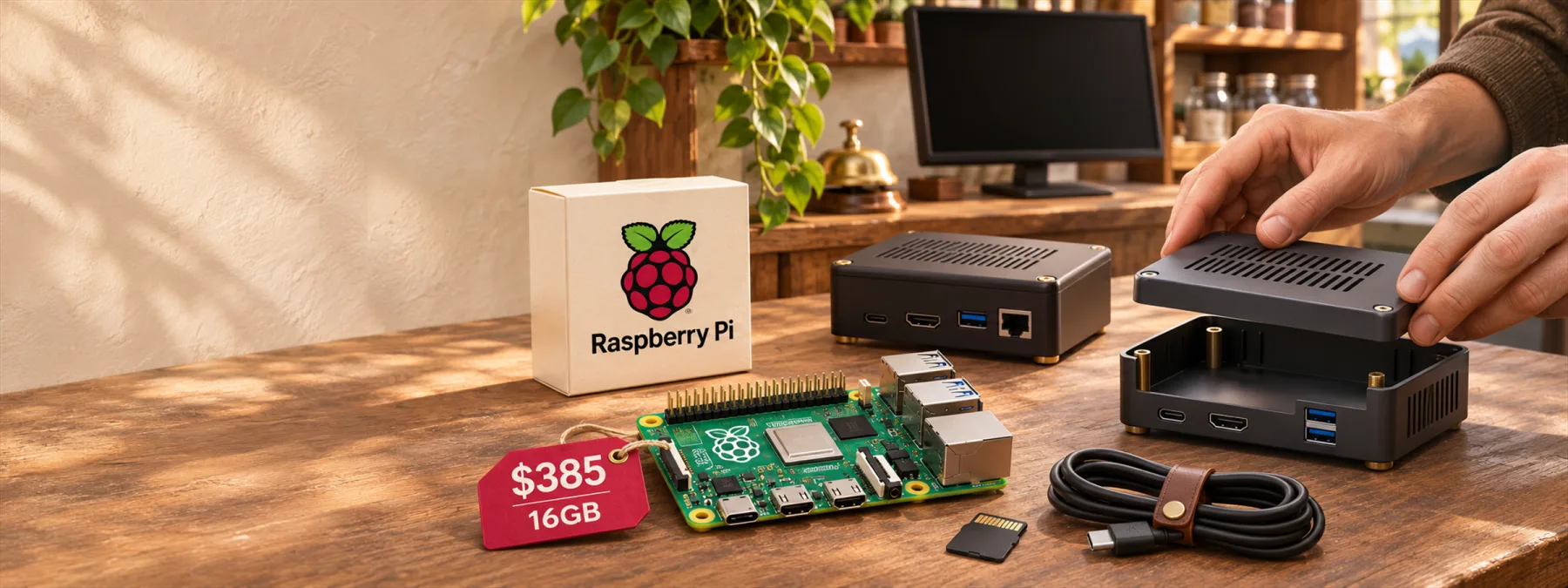
The 16GB Raspberry Pi 5 now costs $385, before you add the rest of the computer. A board small enough to disappear behind a display has become large enough to deserve its own budget conversation.
The Register's November 3 coverage follows a price increase Raspberry Pi announced on November 2: another $80 for the 16GB Pi 5, with 16GB Compute Module 5 variants rising by $40. The company blames limited supplies of high-density memory and other component shortages. This round doesn't cover the whole product range, and the Raspberry Pi 500+ keyboard computer is spared.
I wouldn't read that as a reason to abandon a useful platform. I would retire the assumption that putting a Pi in the proposal automatically makes it the economical option. Small business hardware costs have a way of inheriting yesterday's reputation long after the quote has changed.
The spare you meant to buy
Take an illustrative small shop planning three digital signage players and a fourth machine kept ready as a spare. At the new 16GB Pi 5 board price, those four boards alone total $1,540. The latest $80 increase adds $320 to that plan before anyone orders storage, cases, power supplies or cables.
That doesn't mean a shop's signs need 16GB of memory. That's the interesting part of the example. If nobody has measured the application, the most expensive component may be the words just in case.
I'd want the proposed player running its actual signage software, with the real content, through a busy day. Watch memory use when it starts, updates and handles the heaviest material you expect to show. Leave sensible room for growth, but make that allowance a decision someone can explain. Buying too little can create an unreliable device. Buying the largest option without a reason creates a reliably larger invoice.
Raspberry Pi itself suggests lower-memory variants, earlier models or software memory improvements where those suit the job. Those are options to test, rather than permission to substitute a cheaper board and hope the application behaves.
A board price isn't a finished-device price
The useful comparison is the price of something you can put to work. For a Pi proposal, that means the appropriate power supply, storage, enclosure, any cooling the installation calls for, mounting and setup. Raspberry Pi's own product guidance discusses power and cooling requirements; these aren't decorative extras when the computer has a job to do.
Then there's the less photogenic part of the purchase: who keeps the software current, where the configuration lives, and how quickly a replacement can take over. A spare with no usable configuration is another small project waiting for the day you have the least time for it.
If you're choosing between a Raspberry Pi or mini PC, put the same finished job on both sides of the quote. Include the operating system and application costs that actually apply, support, installation and a practical replacement plan. A cheaper sticker doesn't settle that comparison, and neither does a faster processor.
Some projects have a real reason to use a Pi's size, connectors or existing software. A different computer may require extra development or may not fit the installation. For a straightforward display player, the alternatives may be easier to compare. The point is to price the work you need done, rather than award the contract to a familiar shape.
Raspberry Pi says it hopes to reverse the increases when memory costs fall, but it hasn't given buyers a date to build a budget around. It also directs customers to its Approved Resellers. I'd use a current quote from that channel rather than an old project estimate or an unusually tempting marketplace listing.
For a purchase already on your desk, one fresh quote and one measured trial can be more useful than a complete redesign. Keep the little computer if it earns its place. Give the spare a place in the budget, too.
Sources and further reading