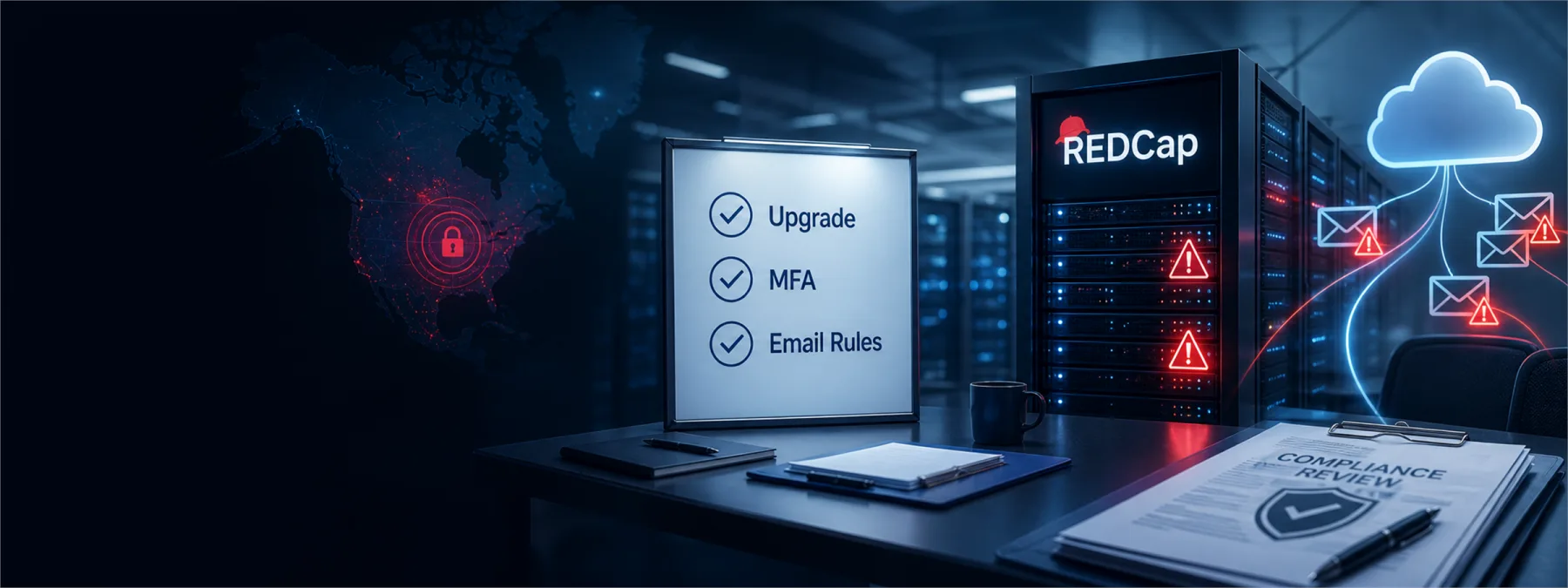
Google Threat Intelligence Group reported on June 15 that a PRC-nexus threat actor tracked as UNC6508 targeted North American medical, academic, and military research organizations. Google said the campaign involved externally facing REDCap systems, stolen credentials, custom INFINITERED malware, and abuse of enterprise content compliance rules to quietly forward selected email traffic.
For business owners, the useful lesson is not limited to REDCap or large research institutions. Many smaller organizations rely on specialized web applications, hosted databases, cloud email platforms, and vendor-managed systems that hold sensitive records. If those systems are exposed, outdated, or loosely governed, a patch ticket alone may not answer the real business question.
The Business Decision Is About Proof
Google said the actor appeared to target vulnerable legacy REDCap versions and later used harvested credentials to reach internal systems. It also described abuse of content compliance rules, a legitimate administrative feature, to silently BCC-forward emails that matched selected topics.
That creates a practical decision for owners and executives: before accepting that a sensitive system is safe, ask what evidence supports that answer. The right proof should cover the application, the administrator accounts, the email environment, and the vendor or internal team responsible for each one.
Questions To Ask Your IT Provider Or Internal Team
- Do we run REDCap or any similar public-facing research, case management, patient, client, donor, student, or operations database?
- Can we prove the current version is installed and that older vulnerable versions were removed, not just left beside the updated version?
- Which administrator accounts can change email routing, forwarding, transport, or compliance rules?
- Are those administrator accounts protected with phishing-resistant multifactor authentication where possible?
- When was the last audit of mailbox forwarding, content compliance rules, transport rules, and external sharing settings?
- If a vendor manages the system, what written evidence will they provide for patch status, old-version removal, log review, and suspicious rule checks?
- Who is responsible for escalating signs of credential theft, unusual email forwarding, or unexplained administrative changes?
What Owners Should Do Next
Start with the systems that hold regulated, confidential, or business-critical data. Ask for an inventory of externally reachable applications and a short written status for each one: owner, vendor, version, exposure, MFA coverage, backup owner, and last review date.
Then ask for a focused email administration review. Silent forwarding and compliance-rule abuse can be easy to miss because the feature itself is legitimate. A clean review should identify who can create those rules, what rules exist today, which ones send data externally, and whether any changes were made without a documented business reason.
The goal is not to panic over every threat-intelligence report. The goal is to turn a technical incident into a clear management standard: sensitive systems need named owners, current versions, retired legacy components, protected administrator access, and periodic proof that email routing rules have not become a quiet data-exfiltration path.
Sources and further reading