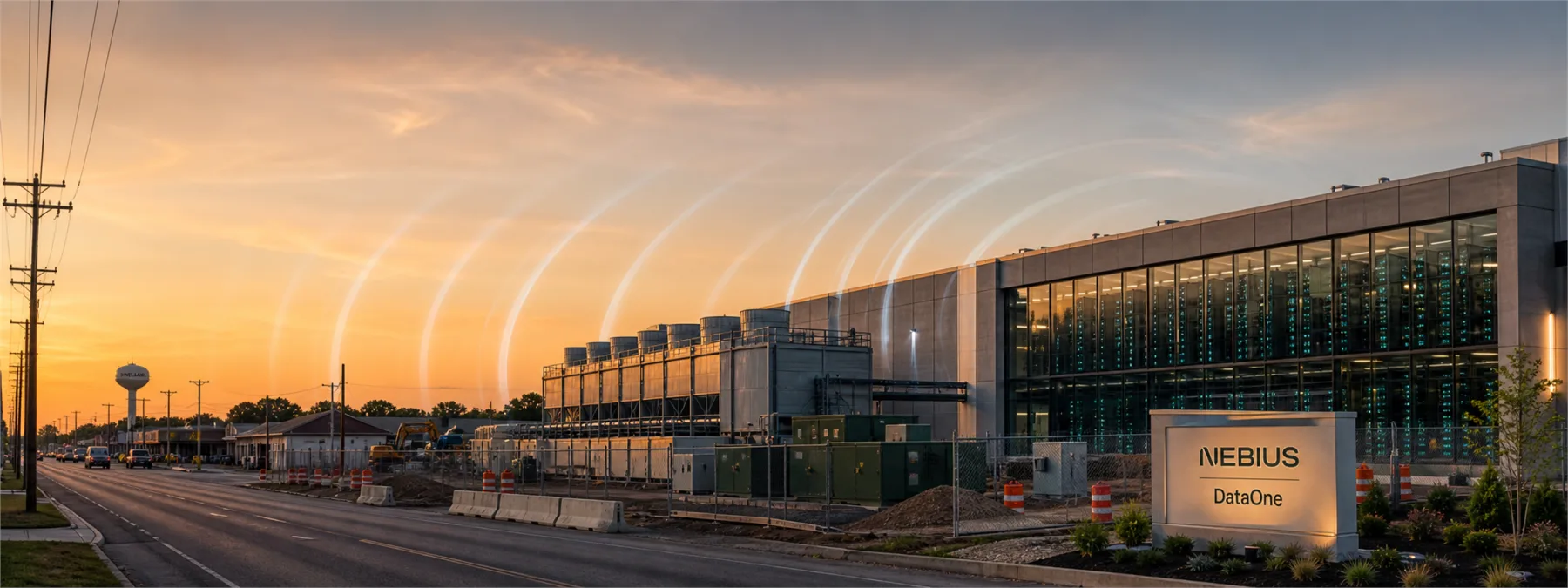
A new report on a Vineland, New Jersey data-center lawsuit puts a very physical issue behind a very digital promise. The Guardian reported on August 28, 2026 that nearby residents have sued over alleged noise from the DataOne data center project tied to Nebius, a large AI infrastructure facility under construction in South Jersey.
The dispute is local, but the lesson travels well. AI, cloud hosting, backup platforms, managed security tools, and software services all depend on real facilities with power, cooling, construction, permits, utilities, neighbors, and contracts. The cloud still has an address. Sometimes it also has a sound.
Nebius' Vineland project page says DataOne is building the facility for Nebius, that Nebius will install and manage the server and GPU infrastructure, and that the project is designed to meet or perform better than sound ordinance levels. The Guardian report describes residents' allegations and also notes DataOne's statement that the company is working on sound mitigation measures. Those facts should be handled carefully: this is a reported legal dispute, not a final finding about fault.
The Business Issue Is The Hidden Infrastructure
For most business owners, a data center can feel distant from daily operations. You buy Microsoft 365, a line-of-business app, backup storage, hosted accounting, managed security, or an AI workflow, and the service arrives through a browser. The facility behind it rarely enters the buying conversation.
That distance can create blind spots. Power plans, cooling designs, energy costs, local permits, water use, noise controls, construction delays, and community opposition can affect the economics and reliability of technology services. Large vendors may absorb those problems. Smaller vendors, regional providers, and fast-growing AI infrastructure companies may pass more of that risk into pricing, availability, contract changes, or service limitations.
New Jersey has already recognized the broader issue. In May 2026, the Governor's Office announced a statewide data-center plan focused on transparency, fair-share energy rules, community-benefits standards, reporting on energy and water use, and local impacts such as light, noise, and pollution.
Vendor Promises Need Operational Proof
The practical question is not whether data centers are good or bad. Businesses need data centers. Healthcare practices need hosted records, manufacturers need remote access and production systems, nonprofits need cloud files, and offices need reliable communication tools. The question is whether the service you are buying has credible operating assumptions behind it.
When a vendor says a platform is resilient, low-impact, green, quiet, fully redundant, or purpose-built for AI, an owner does not need to become a facilities engineer. But the owner should ask what those claims mean in writing. Who owns the facility? Who operates the servers? Who supplies power? What happens if a site faces permitting delays, community restrictions, capacity limits, or utility constraints?
This matters especially when AI is part of the sales pitch. AI workloads can require dense compute, specialized GPUs, unusual cooling demands, and major power commitments. If a provider is depending on a new facility, a third-party buildout, or a still-changing infrastructure market, the buyer should understand whether that creates any timeline, pricing, or continuity risk.
Questions To Ask Before Buying The Cloud Story
Owners do not need to interrogate every data center in a vendor's supply chain. They do need enough detail to separate a dependable service from a marketing story with missing pieces.
- Where will our production data, backups, or AI workload actually run?
- Is the service dependent on a single facility, region, provider, or construction timeline?
- Who owns the data center, who operates the equipment, and who is responsible when the facility has a problem?
- What power, cooling, capacity, and network assumptions are written into the service terms?
- What happens to pricing, performance, or availability if capacity becomes constrained?
- Does the contract include clear service-level commitments, data-location terms, exit rights, and backup or portability options?
- If a vendor makes environmental, resilience, or community-impact claims, can it provide documentation rather than a sales slide?
Those questions are not only for large enterprises. A 20-person business can still be hurt by a cloud service that becomes expensive, unreliable, hard to leave, or dependent on an infrastructure promise nobody verified.
Local Businesses Have Another Stake In The Discussion
The Vineland story also matters because New Jersey businesses may sit on both sides of the data-center conversation. Some will buy services hosted in facilities like this. Others may be neighbors, contractors, landlords, utilities customers, municipalities, school districts, medical providers, or local employers affected by the infrastructure buildout.
That makes the business decision broader than a technology purchase. When a large technology facility enters a local market, leaders should pay attention to power availability, broadband improvements, emergency planning, workforce promises, tax agreements, community-benefits commitments, and public communications. Those details shape whether the project becomes a useful local asset or a recurring operational distraction.
The Practical Next Step
If your business is approving a cloud, AI, backup, hosting, or managed-service proposal this quarter, ask the provider for a short infrastructure-risk summary. It should identify the core hosting regions or facilities, primary dependencies, service-level commitments, backup and recovery design, data portability options, and any known capacity or transition assumptions.
If the provider cannot answer, that does not automatically mean the service is bad. It does mean the decision is not ready for blind approval. The right next step is to clarify the operating model before signing a contract, moving critical data, or building a workflow that will be painful to unwind later.
The Vineland lawsuit is about alleged noise from one local project. The larger lesson for owners is quieter but more important: every digital service has physical dependencies, and the best time to understand them is before the renewal, migration, or AI rollout becomes urgent.
Sources and further reading